 Stephen Dedola
Under 46 CFR 515.21, a US-based NVOCC must carry $75,000 in bond, insurance, or other surety to hold its Federal Maritime Commission (FMC) license. To check a forwarder’s FMC license, match the company name on the FMC list, confirm the bond, and ask who files your customs entry.
NVOCC stands for non-vessel-operating common carrier. It issues its own bills of lading and does not operate the ships (46 CFR 515.2). That means the company you pay usually is not the one whose vessel carries your cargo. Its license and bond are what stand behind the promise.
In this guide
Quick answers
How do I check if a freight forwarder is FMC licensed?
Search the company on the FMC’s ocean transportation intermediary (OTI) list at www2.fmc.gov/oti. The ocean freight forwarder and NVOCC lists each allow you to search by organization name, organization number, license number, trade name, city, or state. The NVOCC list can also be searched by country. Confirm the name matches your quote and invoice, then note the license type. If it isn’t listed, ask why before you book.
What is the difference between an NVOCC and an ocean freight forwarder license?
An ocean freight forwarder (OFF) is US-based and acts on behalf of shippers: it books carrier space and processes documents for shipments leaving the United States, and posts $50,000. An NVOCC is a carrier that issues its own bill of lading and publishes a tariff, but doesn’t run the vessels. It posts $75,000, or $150,000 if it is foreign and registers instead of licensing. On China-to-USA imports, the NVOCC license or registration is usually the one to check.
What is an NVOCC bond, and why does it matter to importers?
An NVOCC bond is the financial security the FMC requires so there’s money to pay claims arising from the carrier’s transportation work. It’s $75,000 for a US-based NVOCC and $150,000 for a foreign NVOCC that registers instead of licensing. That means a valid claim has a surety behind it, not just a promise. The bond is capped at that amount for all claims against the forwarder. This is not cargo insurance, so insure your cargo separately.
What red flags suggest a China-to-USA forwarder isn’t legitimate?
Watch for three signs on the FMC side: no FMC license despite presenting as a US forwarder, a name on the FMC’s list of NVOCCs that haven’t published a tariff, or a bond that belongs to a sister company under the same trade name. The fourth is on the customs side: a forwarder with no broker license that says it handles clearance but will not name the licensed broker who files your entry, or asks you to sign the customs power of attorney with the forwarder instead of with that broker (19 CFR 111.36(c)).
Does a freight forwarder need a US customs broker license?
Only if it files customs entries for you, because the FMC license (46 CFR 515) and the US Customs and Border Protection (CBP) broker license (19 CFR 111) are separate credentials. A forwarder without the CBP license refers you to a licensed broker, who signs the power of attorney with you directly.
What does each license and bond cover?
The FMC licenses ocean transportation intermediaries. CBP licenses customs brokers under a different rule. Here is the split, with the rule behind each credential.
| Credential | Who needs it | Financial security required | Rule |
|---|---|---|---|
| Ocean freight forwarder (OFF) license | US-based company that books space and processes documents for shipments leaving the US | $50,000 | 46 CFR 515.2(m)(1), 515.21(a)(1) |
| NVOCC license | NVOCC with its main place of business in the US | $75,000 | 46 CFR 515.21(a)(2) |
| NVOCC registration | NVOCC based outside the US that registers with the FMC instead of licensing | $150,000 | 46 CFR 515.2(r), 515.21(a)(3) |
| Published NVOCC tariff | Every NVOCC, licensed or registered | Not applicable | FMC OTI page; 46 CFR 520.3(a) |
| CBP customs broker license | Anyone transacting customs business for others | Not set by FMC rules | 19 CFR 111.2(a)(1) |
A Chinese NVOCC can carry your cargo through FMC registration rather than a US license. It posts $150,000, twice the US figure.
If your forwarder issues the house bill of lading, it is acting as an NVOCC (46 CFR 515.2(k)). Check that license type, not only the ocean freight forwarder box.
How do you check a forwarder’s FMC license?
Run the lookup before you sign, and again if the name on the invoice changes.
- Collect the exact legal name from the quote or contract, plus any organization or license number the forwarder gives you.
- Open the FMC OTI list at www2.fmc.gov/oti. Search the ocean freight forwarder list and the NVOCC list by name, organization number, license number, trade name, city, or state. The NVOCC list can also be searched by country. The full list downloads as Excel, PDF, XML, or CSV.
- Compare the record with your paperwork. The legal name should match the company billing you.
- Check the tariff location on the FMC’s “NVOCC tariffs online” list. Open the tariff location the FMC shows. If it does not open, ask.
- Search the non-compliant list. The FMC names NVOCCs that have not published a tariff.
- Ask the FMC if the names do not match. Bureau of Certification and Licensing (licensing and financial responsibility): 202-523-5843 or [email protected].
How do you confirm the bond is real?
The bond, insurance, or other surety covers the OTI’s transportation-related activities (46 CFR 515.21(a)). The FMC describes it as proof of financial responsibility for paying claims. If the forwarder does not pay, you can seek payment from the surety. If the forwarder contests the claim and it is not settled within 90 days, the bond is available to pay a final court judgment or FMC reparations order (46 CFR 515.23(b)). The surety’s total for all claims cannot exceed the bond amount. It is a backstop, not cargo insurance, so insure your cargo separately.
Ask for the bond number and the surety company. Then match the amount to the license type in the table above. A sister company’s bond does not cover you. Under 46 CFR 515.21(c), each company that provides OTI services under a common trade name needs its own financial responsibility.
What does the tariff tell you?
Every NVOCC must publish a tariff open to public inspection. It files Form FMC-1 before a license is issued and must update that form within 30 days of any change (46 CFR 520.3(d)).
Since August 31, 2023, the FMC has posted the names of NVOCCs that do not publish a tariff, and it updates the list weekly. Companies on it risk losing the license or the registration. If your forwarder is on the list, ask for a compliance date in writing.
When does your forwarder also need a customs broker license?
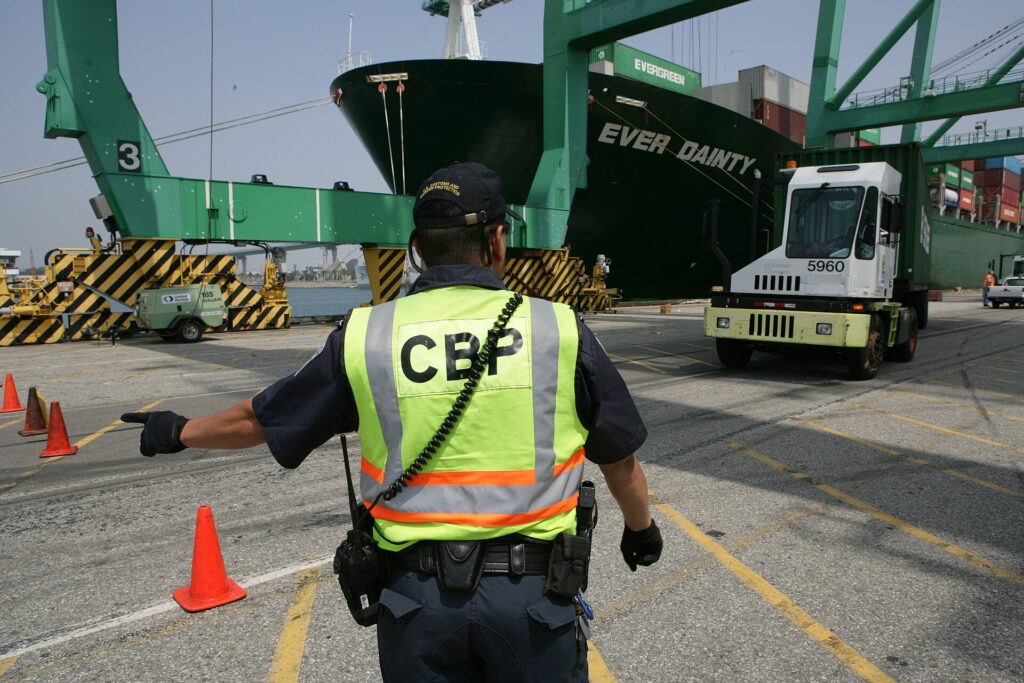
Moving the container and clearing it are different jobs. The FMC license covers the ocean move. Clearing your goods is customs business, and 19 CFR 111.2(a)(1) says a person needs a CBP license to transact it as a broker.
You can file entries for your own goods (19 CFR 111.2(a)(2)(i)). Your forwarder cannot file them for you without a broker license. Ask: “Who files my entry, and under which broker license?” CBP publishes a Permitted Customs Brokers Listing you can check the answer against.
Where do industry memberships fit?
The National Customs Brokers & Forwarders Association of America (NCBFAA) runs a broker and forwarder directory under “Search Our Membership.” Membership is not a license. Use it after the FMC and CBP checks, not instead of them.
CTPAT sits in a different category. It is CBP’s voluntary supply chain security program, and CBP validates each partner rather than taking a membership fee. CTPAT is a CBP program, not a trade association. Ask the forwarder for proof of its certification and the year it joined.
What does a completed check look like?
Here is the same check on one forwarder, the publisher of this guide, using the FMC OTI list download dated November 17, 2026. You can check any forwarder the same way.
Search the NVOCC list for “Dedola”. The record is Dedola Global Logistics, Cypress, California. The company is also on the ocean freight forwarder list. The FMC’s note on the OTI list page says a company on both lists is licensed as both. A license-number search for 020963 lists the same company first. The search result also shows a China Bond Rider Effective Date, which is December 1, 2015 on this record. The rider is optional (46 CFR 515.25(b)) and makes money available to pay fines and penalties that Chinese authorities impose for activities in the US-China trades (46 CFR 515, Appendix E).
The search screen does not display the bond number, the bond amount or the tariff. The FMC’s note on that list page says listed companies have complied: license obtained, proof of financial responsibility submitted, and, for NVOCCs, a current Form FMC-1 on file. The list download, not the search screen, is where the bond number sits. On that row, the NVOCC bond is #IT1445NVO for $75,000, issued by U.S. Specialty Insurance Company. The license renewal date on the same row is March 31, 2027. The ocean freight forwarder bond on that same row is a separate instrument. Match the bond you were given to the license type you are buying.
Then search the NCBFAA directory for the company name. Dedola is not a customs broker. Its clients sign the customs power of attorney directly with Dedola’s licensed broker partner, which files the entry. On CTPAT, Dedola is a CTPAT Certified Partner since 2006, validated by CBP. Run the same steps on any forwarder you are comparing.
What should you do next?
Run the FMC license lookup on your current forwarder this week, and on any new one before you sign. The non-compliant NVOCC list updates weekly, so check it again within a week of your next booking.
If Dedola is one of the forwarders you are checking, the services page and the ocean freight, air freight, and supply chain pages set out what each service covers, so you can match the license type to the work you are buying.
Your verification checklist
- Check the FMC OTI record for the legal name on your invoice. A trade name can hide a different company.
- Confirm the license type matches the service. A company issuing your bill of lading should be an NVOCC, licensed or registered.
- Confirm the bond amount fits the license type. The three figures in 46 CFR 515.21 are $50,000, $75,000, and $150,000.
- Ask for the bond number and surety. Each company under a shared trade name needs its own.
- Check the published tariff location. Every NVOCC must keep a public tariff.
- Review the FMC’s list of non-compliant NVOCCs. It is updated weekly.
- Confirm who files your customs entry and under which CBP broker license.
- Check the NCBFAA member search only after the licenses match.
- Ask for proof of CTPAT certification and the year the forwarder joined.
- Write down what you found and the date. You will want it if the invoice name changes.
FAQs
Can a forwarder based in China carry my cargo without a US license?
Yes, if it registers with the FMC as a foreign NVOCC. A registered NVOCC has its main place of business outside the US, posts $150,000 in financial security, and publishes a tariff (46 CFR 515.2(r), 515.21(a)(3)). Check for the registration the same way you check for a license.
Can two related companies share one bond?
No. Under 46 CFR 515.21(c), each company providing OTI services under a common trade name needs its own proof of financial responsibility. Ask which legal entity the bond names.
Who do I contact at the FMC about a license or bond?
The FMC lists 202-523-5843 and [email protected] for OTI licensing and financial responsibility, and 202-523-5787 for questions about the OTI list itself. Give them the company’s legal name and any organization number you have.
Do I need a customs broker if I file my own entries?
No. An importer handling customs business only for its own goods needs no broker license (19 CFR 111.2(a)(2)(i)).
Does a customs broker license cover every US port?
A broker’s national permit covers customs business anywhere in the US customs territory (19 CFR 111.2(b)). A broker does not need a separate license for each port your containers use.
More questions about working with Dedola are on the Dedola FAQ page.
Related reading
Keep going with the rest of the China to USA series.
Sources
- 46 CFR 515.2, Definitions (eCFR), 80 FR 68730, November 5, 2015. https://www.ecfr.gov/current/title-46/section-515.2
- 46 CFR 515.3, License; when required (eCFR), 85 FR 9683, February 20, 2020. https://www.ecfr.gov/current/title-46/section-515.3
- 46 CFR 515.21, Financial responsibility requirements (eCFR), last amended 85 FR 9683, February 20, 2020. https://www.ecfr.gov/current/title-46/section-515.21
- Federal Maritime Commission, Ocean Transportation Intermediaries (page modified June 10, 2024). https://www.fmc.gov/about/bureaus-offices/bureau-of-enforcement-investigations-and-compliance-beic/office-of-compliance/ocean-transportation-intermediaries/
- Federal Maritime Commission, NVOCC tariffs online. https://www2.fmc.gov/fmc1reports
- Federal Maritime Commission, Industry Advisory: Names of Non-Compliant NVOCCs Posted to FMC Website, August 31, 2023. https://www.fmc.gov/articles/industry-advisory-names-of-non-compliant-nvoccs-posted-to-fmc-website/
- 19 CFR 111.2, License and permit required (eCFR), last amended CBP Dec. 22-21, 87 FR 63313, October 18, 2022. https://www.ecfr.gov/current/title-19/section-111.2
- Federal Maritime Commission, OTI list download, list as of September 26, 2026 13:30:02 EST, and the OTI list page note on compliance. https://www2.fmc.gov/oti/ and https://www2.fmc.gov/oti/NVOCC.aspx
- NCBFAA, Search Our Membership, verified September 26, 2026. https://ncbfaa.org/search-our-membership
- US Customs and Border Protection, Permitted Customs Brokers Listing, verified September 26, 2026. https://www.cbp.gov/about/contact/brokers-listing
- US Customs and Border Protection, CTPAT: Customs Trade Partnership Against Terrorism, verified November 5, 2026. https://www.cbp.gov/border-security/ports-entry/cargo-security/ctpat
- 46 CFR 515.23, Claims against an ocean transportation intermediary (eCFR), last amended 84 FR 62468, November 15, 2019. https://www.ecfr.gov/current/title-46/section-515.23
- 46 CFR 520.3, Publication responsibilities (eCFR), 89 FR 30, January 2, 2024. https://www.ecfr.gov/current/title-46/section-520.3
- 19 CFR 111.36, Relations with unlicensed persons (eCFR), last amended CBP Dec. 22-21, 87 FR 63318, October 18, 2022. https://www.ecfr.gov/current/title-19/section-111.36
- 19 CFR 143.1, Eligibility (eCFR), last amended CBP Dec. 17-13, 82 FR 45406, September 28, 2017. https://www.ecfr.gov/current/title-19/section-143.1
- 46 CFR 515.25, Filing of proof of financial responsibility (eCFR), last amended 84 FR 62468, November 15, 2019. https://www.ecfr.gov/current/title-46/section-515.25
- Appendix E to 46 CFR Part 515, Optional Rider for Additional NVOCC Financial Responsibility (Optional Rider to Form FMC-48) (eCFR), 80 FR 68738, November 5, 2015. https://www.ecfr.gov/current/title-46/part-515/appendix-Appendix%20E%20to%20Part%20515