
Apparel seasonality still massively impacts logistics planning, but it certainly isn’t the only thing driving volatility in 2026. Today’s importers have to navigate aggressive tariff policies and geopolitical instability alongside traditional peak periods. Sudden regulatory changes and the 10% global import surcharge implemented in February create an environment where historical data fails to accurately predict costs. Making matters worse, ongoing conflict in the Middle East is pushing oil prices higher, directly inflating costs on critical trade lanes worldwide. In response, carriers have announced an Emergency Bunker Surcharge (EBS) effective April 8, ranging from $400–$600 per container to offset rising operating costs.
These factors are already leading to double-digit rate hikes and surcharges that immediately erode apparel margins. Geopolitical friction also creates a constant scramble for vessel space, triggering early volume surges and port congestion months before the traditional peak. Logistics success relies on identifying market volatility early enough to secure capacity before rates spike. This article details the 2026 apparel import calendar and strategies to avoid the year’s costliest surcharge windows.
The Apparel Shipping Calendar: Peak Seasons and 2026 Uncertainty
The 2026 apparel shipping calendar no longer follows a fixed script. While seasonal demand still drives volume, rate hikes and capacity crunches now change in response to trade policy and geopolitical events. Navigating this environment requires balancing traditional retail deadlines with the unpredictable nature of modern surcharges.
Chinese New Year (January–February)
Chinese New Year is a primary disruptor in the apparel supply chain. While the official holiday period ends in late February, the logistical impact stretches well into March. Factories typically begin tapering output weeks before the holiday, and garment manufacturing across China and Vietnam often takes until mid-March to reach full capacity.
In the current market, the expected post-holiday rate drop hasn’t materialized. Carriers continue to manage supply through blank sailings, which keeps pricing firm and space inconsistent. As factories ramp back up, rolled bookings remain common, especially on departures from Ningbo and Shanghai, with Busan currently seeing some of the most frequent one-week rollovers. To reduce disruption and avoid premium add-ons, shippers should plan to book 4–6 weeks ahead during this recovery period.
The Shoulder Season (March–April)
The period following the post-holiday recovery usually offers a brief window of higher equipment availability. As factories return to full speed in late March, ocean carriers often struggle to fill vessels, leading to a temporary dip in spot rates, making it a good time to pivot from expensive air freight back to ocean services for summer replenishment. Shippers use this period to move core basics at a significantly lower cost per unit. However, with 2026 fuel prices rising, even this quieter window is subject to higher-than-average rates.

The Summer Surge and Back-to-School (May–July)
Summer marks a critical window for back-to-school clothing imports, but 2026 brings new variables. In 2025, fear of tariff hikes led to massive front-loading during these months, and that trend continues to threaten stability. Because the outcomes of current Section 301 investigations remain unknown, predicting exactly when a surge might hit is difficult.
If importers pull inventory forward to avoid potential trade barriers, the higher rates currently seen in the market may seep directly into the summer. This would disrupt what is typically a stable and predictable shipping period, potentially overlapping back-to-school volumes with early holiday preparations.
Traditional Peak (August–October)
The traditional peak season remains centered on winter holidays. Retailers typically move high volumes of seasonal collections during this window to ensure shelves are stocked for Black Friday. Expect maximum capacity tightening and the highest annual surcharges during these months. For 2026, the convergence of this retail demand with ongoing Red Sea diversions means Trans-Pacific transit times will likely remain extended, requiring a 30-day buffer for all holiday-critical shipments.
Year-End Front-Loading (November–December)
The final months of the year typically offer a calmer shipping environment as holiday inventory is already stateside. Proactive apparel importers use this lull to their advantage. By front-loading shipments for spring collections in November and December, brands can avoid the chaos and premium pricing of the pre-Chinese New Year rush. Securing vessel space during this window provides a cost-effective head start on the following year’s production cycle
2026 Capacity Booking Strategy: China to USA
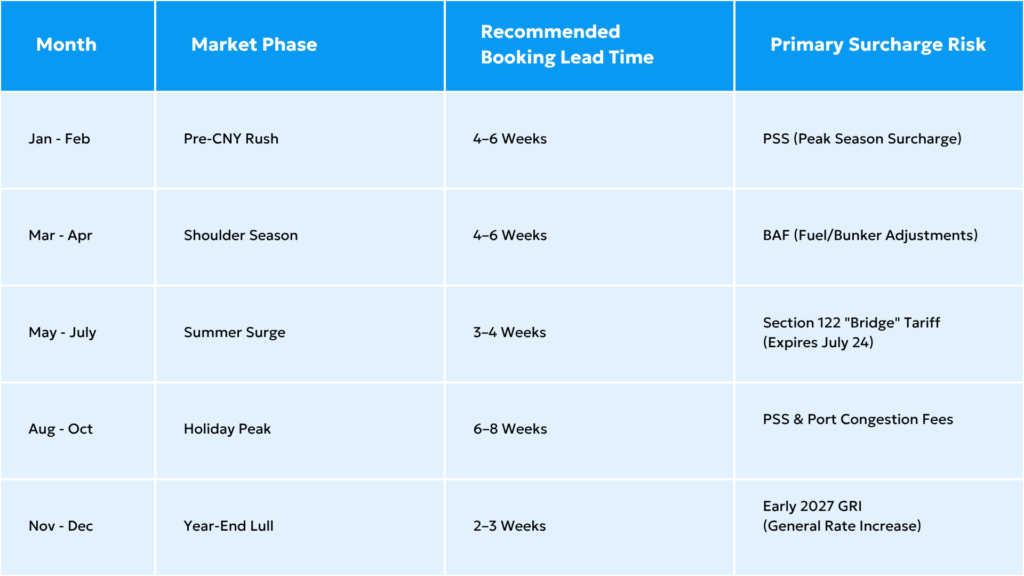
The March 2026 market shows a 10% capacity surplus, yet Trans-Pacific rates remain volatile due to aggressive blank sailings and fuel surcharges. Use the following windows to secure space and mitigate rate spikes when importing clothing from China.
Managing Surcharges and Protecting Your Margins in 2026
In today’s market, the base rate quoted for a container is rarely the final price. Surcharges have evolved from seasonal adjustments into primary cost drivers that can change week to week. Even as the Freightos Baltic Index (FBX) suggests relative rate stability on the Trans-Pacific, total landed costs are still being pushed up by layered accessorial fees and surcharges.
Understanding 2026 Surcharges
Carriers use three primary levers to adjust pricing outside of the base ocean freight rate. Understanding these triggers is the first step toward accurate landed cost modeling.
- Peak Season Surcharge (PSS): Historically applied from August to October, PSS is now triggered whenever capacity tightens, often earlier in the year. Current 2026 estimates range from $400 to $600 per FEU, depending on the carrier.
- General Rate Increases (GRI): Structural increases to the base rate, typically announced at the beginning of the month. Carriers attempted a $1,000 GRI in early March, though market pressure has kept actual increases closer to $200–$300.
- Emergency Bunker Surcharge (EBS) / BAF: Fuel adjustments driven by crude oil price movement. In 2026, carriers are updating these charges frequently, and the newly announced EBS will replace the previous fuel surcharge structure.
- Port Congestion Surcharge: Applied when vessel dwell times at LA/Long Beach exceed 48 hours. Current 2026 triggers for this fee are highly sensitive to front-loading surges.
The 2026 Capacity Crisis
Capacity is tightening now due to structural imbalances rather than a simple lack of ships. Massive vessel overcapacity exists globally, but effective capacity (the space actually available for your cargo) is restricted by two main factors:
- Blank Sailings: Carriers are aggressively canceling scheduled sailings to artificially limit supply and maintain rate baselines.
- Equipment Shortages: Ongoing diversions around the Cape of Good Hope extend transit times by 10 to 14 days. This keeps containers on the water longer, preventing them from returning to Asian hubs for reload and creating localized equipment droughts at key ports.
The Section 122 “Tariff Surcharge”
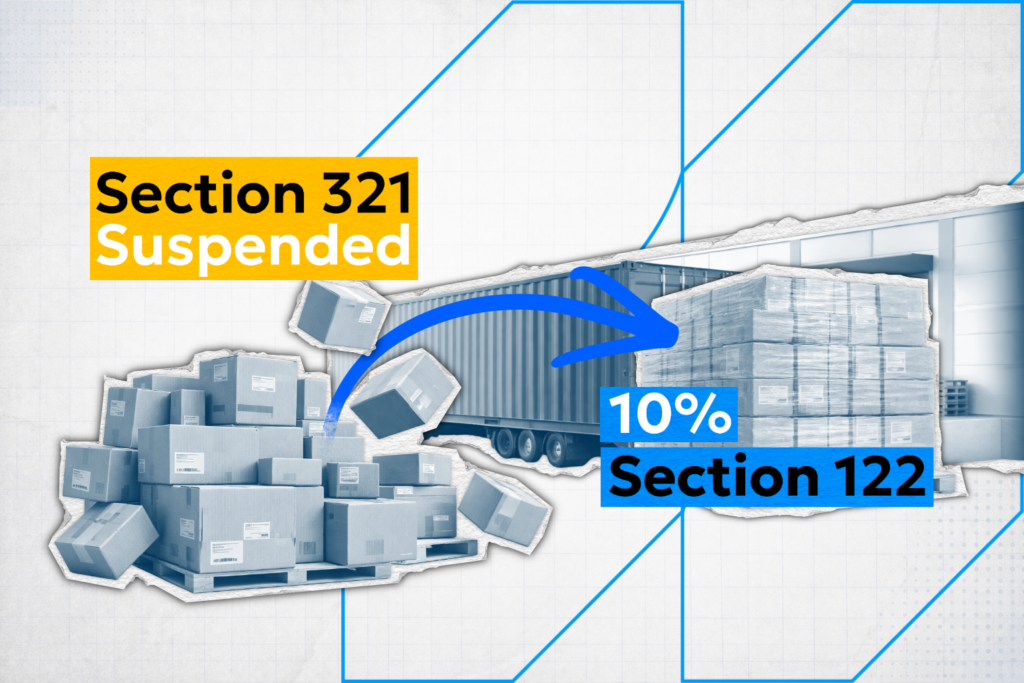
The most significant development for 2026 is the implementation of the Section 122 temporary import surcharge. Following the Supreme Court ruling that struck down previous IEEPA-based tariffs, the White House invoked Section 122 of the Trade Act of 1974. This was done to address the national trade deficit and balance-of-payments problems.
As of February 24, a 10% flat surcharge applies to most US imports. By law, this surcharge is temporary and capped at 150 days, meaning it currently expires on July 24, 2026. For apparel importers, this creates a high-stakes window. While goods from Central American countries remain exempt from this duty, almost all apparel originating in China is subject to the 10% hike. Some clothing brands are proactively modeling Q2 and Q3 shipments to arrive before this 150-day window closes, as the post-July regulatory environment remains uncertain.
Apparel Consolidation: The Strategy to Beat High Rates
When ocean rates spike, paying for the air in a half-empty container becomes a major liability. Most apparel importers move orders that don’t completely fill a 40-foot container, resulting in unnecessary wasted spend. Apparel consolidation from China to USA offers a solution by grouping multiple smaller shipments into a single, high-density load to lower the per-unit freight cost.
Choosing the right consolidation method depends on your vendor network and required level of control:
- Standard LCL: Your cargo is co-loaded with goods from other companies. This is the most flexible choice for shipments between 1 and 12 pallets. Once you exceed 12 pallets, the LCL handling fees and per-CBM markups usually exceed the cost of a dedicated 20-foot container.
- Buyer’s Consolidation: This method turns fragmented vendor orders into a private, high-volume flow. A logistics partner gathers specific SKUs from your various garment factories into a single dedicated container. This eliminates the individual warehouse fees of standard LCL and allows you to dictate the loading priority and transit schedule for your entire seasonal line.
- Regional Hub Integration: Dedicated hubs in garment clusters like Yiwu and Guangzhou provide a final gatekeeper for quality control. Moving inspection to the consolidation point identifies defects before the goods leave China. This prevents you from paying international freight and the 2026 10% import surcharge on unsellable inventory.

LCL vs. FCL: Calculating the Break-Even Point
Choosing between LCL and FCL depends on the total volume of your seasonal line. For most apparel brands, the break-even point falls between 13 and 15 cubic meters (CBM).
- Above 15 CBM: The flat rate of a 20-foot FCL container usually becomes cheaper than the cumulative per-CBM handling fees and warehouse charges of LCL
- Below 13 CBM: LCL consolidation is typically the most cost-effective, allowing you to pay only for the volume used.
Partnering for Precision Apparel Logistics
Relying on static quotes in a market defined by double-digit rate hikes and aggressive blank sailings simply is not a reliable strategy. With the July 24 expiration of the Section 122 surcharge approaching, the ability to model landed costs in real-time is the only way for apparel brands to protect their seasonal margins.
Dedola Global Logistics provides the technical infrastructure to navigate these shifts. Our TrakItPRO platform delivers the line-item visibility required to manage volatile fuel surcharges and capacity tightening across all Trans-Pacific lanes. With 50 years of experience in textile and garment logistics, we ensure your shipments bypass port congestion and clear customs before new trade barriers take effect.
Apparel Importing FAQs
How do I manage apparel logistics surcharges in 2026?
Manage surcharges by moving away from fixed annual contracts and utilizing a mix of spot rates and short-term “named account” agreements. In 2026, focus on identifying the trigger points for Peak Season Surcharges (PSS) and Emergency Bunker Surcharges (EBS) early.
What is the best time to ship apparel from China to the USA in 2026?
While March and April technically offer lower base rates, the “best” time in 2026 is governed by the Section 122 tariff window. To protect margins, the optimal strategy is to ship as much inventory as possible before the late-May/early-June cutoff. This ensures your goods clear US Customs before the 10% surcharge potentially expires or increases on July 24. Waiting for the traditional low-rate windows later in the year carries the high risk that new trade barriers will override any small savings in ocean freight.
When does apparel consolidation from China to the USA beat direct FCL?
Consolidation is the better option when your total shipment volume falls below 13–15 cubic meters (CBM). Below this break-even point, the per-unit cost of LCL (Less than Container Load) is typically lower than the cost of paying for the unused space in a 20-foot Full Container Load (FCL). Consolidation also allows brands sourcing from multiple factories to aggregate goods into a single entry, reducing customs filing fees and domestic drayage costs.
Connect with us to review your 2026 shipping strategy and secure your capacity for the year ahead.