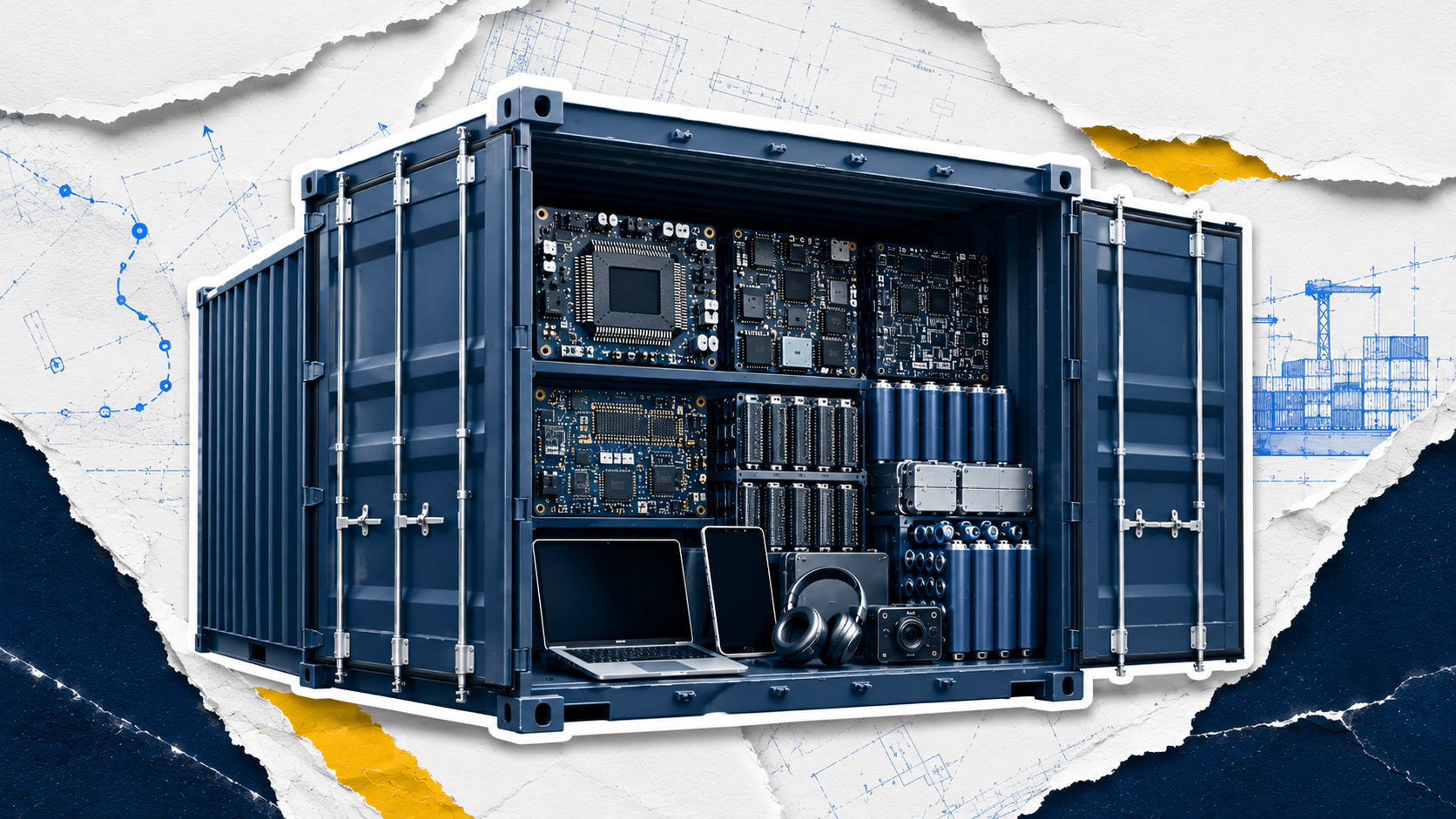
Electronics imports from China have never been more complicated. Tariff structures are in flux, compliance requirements are strict, and freight costs are spiking at a pace that makes last quarter’s landed cost calculations unreliable. Importers who underestimate this complexity often pay for it in customs holds, unexpected duties, and missed delivery windows.
This article covers what matters most in 2026: how to choose the right freight mode, what the current tariff environment means for your products, and how to get your documentation right before the cargo moves.
Tariffs on Electronics from China: 2026 Update
Tariffs on Chinese electronics vary significantly by product. Baseline import duties, Section 301 tariffs, and recent executive actions all apply differently depending on what you’re importing and how it’s classified.
The broad strokes:
- Finished consumer goods (smartphones, laptops, tablets, flat-panel TVs) are largely exempt from the most punitive reciprocal tariffs, though baseline duties still apply.
- Specialized components (PCBs, capacitors, resistors, connectors) frequently carry additional Section 301 tariffs ranging from 25% to 30%.
- Semiconductors and chips face the steepest exposure, with duties reaching as high as 50%.
| Product Category | HTS Code | Approx. 2026 Duty Rate |
|---|---|---|
| Smartphones | 8517.12.00 | Baseline only (exempt from reciprocal) |
| Laptops/Tablets | 8471.30.01 | Baseline only (exempt from reciprocal) |
| Printed Circuit Boards | 8534.00.00 | 25–30% |
| Lithium Batteries | 8507.60.00 | ~23% |
| Semiconductors | 8542.31.00 | Up to 50% |
A note on the current trade environment: As of late May 2026, the U.S. and China appear to be moving toward an agreement on tariff restoration following the Trump-Xi meetings in Beijing.1 xOngoing Section 301 investigations are expected to conclude this summer, with rates potentially settling at 10% per investigation. Nothing is final, and the situation is still developing.
Because rates shift with little warning, verify your product’s exact duty rate through the USITC HTS Search tool2 before committing to a purchase. The USTR website tracks Section 301 exclusions and modifications in real time. Licensed customs brokers and knowledgeable freight forwarders are the most reliable resource for commercial shipments.
Freight Options for Shipping Electronics from China to the U.S.
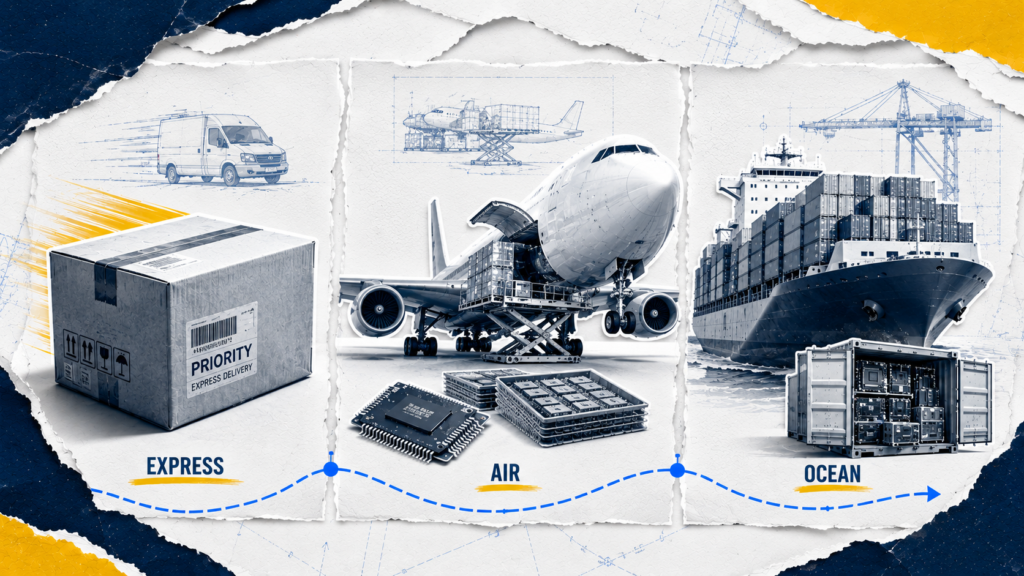
Choosing the right freight mode comes down to three factors: shipment size, timeline, and the nature of your cargo. Here is how each option stacks up in current market conditions.
Express Shipping
Express is the right call for samples, product launches, and small parcels under 150 kg. Couriers like DHL move shipments door-to-door in 2 to 4 days, and the speed premium is easy to justify when you are validating a supplier or getting a high-margin product to market fast. Since this is typically the most expensive option, reserve it for shipments where speed justifies the higher cost.
Air Freight
Air freight is the practical middle ground for shipments in the 150 to 500 kg range, time-sensitive inventory replenishment, and high-value-per-kilo goods like semiconductors and drones. Transit times run 2 to 3 days to JFK or LAX, though air rates fluctuate significantly and should be confirmed with your freight forwarder at time of booking.
One important cost variable for electronics shippers: lithium battery shipments require enhanced IATA dangerous goods packaging and documentation. Budget an additional $200 to $400 per shipment to cover compliant packaging and the paperwork that goes with it.
Ocean Freight (FCL and LCL)
Ocean freight is the default mode for bulk electronics, industrial machinery, and any non-urgent inventory where cost efficiency outweighs speed. Transit to major U.S. ports runs 14 to 22 days under current conditions.
The decision between FCL and LCL comes down to volume:
- LCL (Less than Container Load): Best for shipments under 15 CBM with transit times of 10 to 17 days. LCL has historically been the more stable pricing option for non-FCL volumes, though rates should always be verified before booking.
- FCL (Full Container Load): Better protection and control for larger or sensitive electronics shipments. Rates vary considerably by lane and market conditions, so get current quotes from your forwarder and consolidate into 40HQ containers where volume allows.
Trans-Pacific capacity has been under significant pressure, with West Coast lanes experiencing equipment tightening and East Coast routes facing additional strain from Suez-related rerouting. Early booking and volume consolidation are the most effective ways to manage cost exposure in this environment.
Importing Electronics: A Step-by-Step Pre-Shipment Checklist
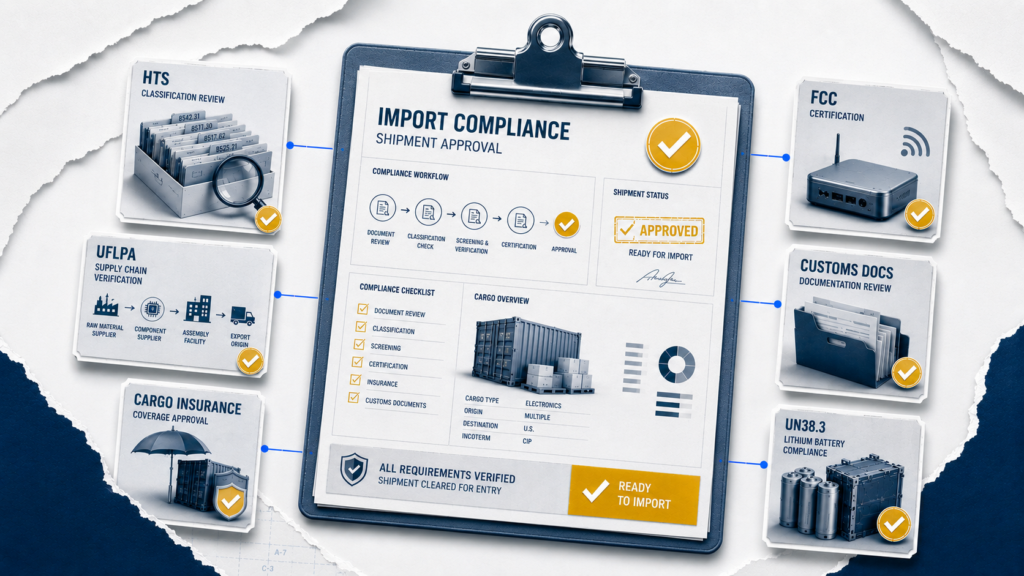
Electronics shipments from China require more preparation than most general freight categories. Work through these steps before your cargo moves.
1. Calculate Your Total Landed Cost
Freight charges are only one line item in your total shipping costs. Before committing to a purchase, account for all of the following:
- Applicable tariff rate based on your HTS classification
- Customs clearance fees ($150 to $300 typically)
- Inland transport from the port to final destination
- Cargo insurance (typically 0.5% to 1% of cargo value)
- Accessorial fees (fuel surcharges, security fees, port handling)
- Lithium battery packaging and documentation if applicable
Importers who skip this step often discover their margins are far thinner than expected after the shipment arrives.
2. Verify Your HTS Classifications
Use CBP’s Customs Rulings Online Search System (CROSS)3 to confirm your product’s classification before it ships. Given how differently electronic categories are treated under current tariff structures, a misclassification can mean a dramatically higher duty rate than anticipated, and in some cases, the difference between a 0% and a 50% duty rate on the same physical product.
For commercial shipments, a credible freight forwarder with extensive customs experience is the most reliable resource for getting this right. Small changes to product design, packaging, or assembly process can shift an HTS classification entirely, and a forwarder with electronics experience will identify those opportunities before your cargo moves.
3. Map Your Supply Chain for UFLPA Compliance
The Uyghur Forced Labor Prevention Act (UFLPA)4 requires importers to prove their goods were not produced using forced labor from the Xinjiang region of China. CBP operates under a rebuttable presumption standard, meaning the burden of proof falls on the importer, not the government. For electronics, CBP has designated lithium, copper, and steel as high-priority materials under the Act. Any shipment containing these materials faces enhanced scrutiny and a potential 30- to 60-day detention while CBP investigates.
To avoid holds, work with your suppliers to document the entire supply chain from raw materials to finished products. Require signed declarations from all sub-suppliers and maintain those records in an audit-ready format.
4. Confirm Battery Certifications and Packaging
Lithium batteries are one of the most tightly regulated cargo types in international freight. Every shipment containing them requires a current UN38.3 test certificate confirming the battery has passed the required safety tests for transport.
For air shipments, IATA Dangerous Goods Regulations5 require fully compliant packaging and a complete set of hazmat documentation. Undeclared or improperly packaged batteries result in automatic shipment rejection, and in some cases, carrier bans. Verify all certifications directly with your supplier before the shipment is booked.
5. Prepare Your Documentation Package
CBP expects complete, precise documentation. Vague descriptions like “electronic parts” will likely get your shipments flagged for inspection. Each item requires a specific description and its corresponding HTS code. Your full package should include:
- Commercial invoice with precise HTS codes
- Detailed packing list with itemized weights and dimensions
- ISF filing (submitted at least 24 hours before vessel departure)
- Certificate of Origin
- FCC Equipment Authorization (for any RF-emitting devices)
- UFLPA supplier declarations and supply chain mapping
- UN38.3 test summary and MSDS for lithium batteries
6. Secure Cargo Insurance
Electronics are among the highest-risk cargo categories for theft and damage. Standard carrier liability is limited and rarely covers the full value of a loss. At minimum, secure coverage for 110% of your shipment’s commercial value.
For high-value loads like semiconductors or medical devices, consider specialized cargo insurance that covers all-risk scenarios, including theft, moisture damage, and handling errors. Your freight forwarder can help you identify the right policy for your cargo type and shipping lane.
Ship Smarter with Dedola Global Logistics
Electronics from China require a freight partner who understands more than transit times and container rates. Tariff exposure, HTS classifications, UFLPA compliance, and battery certifications all affect how your shipment moves, what it costs, and whether it clears customs without a hold.
Dedola’s team works with electronics importers to navigate all of it, from freight mode selection to documentation review to customs clearance. Talk to a Dedola freight specialist before your next shipment.
FAQs
How long does ocean freight from China take in 2026?
Transit times to major U.S. ports currently run 14 to 22 days for FCL shipments and 10 to 17 days for LCL. Build in additional buffer for customs clearance and inland transport. Trans-Pacific capacity pressure is causing periodic delays, so secure capacity early and pad your timelines accordingly during peak periods.
What is the cheapest way to ship electronics from China to the U.S.?
LCL ocean freight is the most cost-stable option as of May 2026, making it the right choice for smaller, non-urgent shipments. For larger volumes, FCL becomes more economical despite the current rate surge. Air and express are significantly more expensive and best reserved for time-sensitive or high-value cargo where speed justifies the cost.
Do all electronics from China require FCC certification?
Not all, but most. Any device that emits radio frequency energy requires FCC Equipment Authorization. This includes Bluetooth devices, WiFi-enabled products, cellular devices, and wireless chargers. Devices that do not emit RF energy but may still generate unintentional radiation, such as power banks or basic wired headphones, require a Supplier’s Declaration of Conformity instead. Undeclared RF devices are subject to immediate seizure at the border.
What is UFLPA and does it affect my shipment?
The Uyghur Forced Labor Prevention Act prohibits the import of goods produced wholly or in part with forced labor from China’s Xinjiang region. CBP operates under a rebuttable presumption standard, meaning any goods that touch Xinjiang-linked supply chains are presumed inadmissible unless the importer proves otherwise. Electronics shipments containing lithium, copper, or steel are high-priority targets for UFLPA enforcement. If your supply chain documentation is incomplete, your shipment can be detained for 30 to 60 days while CBP investigates.
How do I know if my HTS code is correct?
Start with CBP’s Customs Rulings Online Search System (CROSS), which lets you search past rulings by product type and find how similar goods have been classified. For commercial shipments, a licensed customs broker or freight forwarder is the most reliable verification resource. If you have significant import volume and have not had a formal classification review recently, it is worth doing one. Incorrect codes trigger audits, penalty assessments, and in some cases, a higher duty rate than you should be paying.
Sources
- Reuters – “US not in a hurry to extend China trade truce”
- U.S. International Trade Commission – Harmonized Tariff Schedule
- U.S. Customs and Border Protection – Customs Rulings Online Search System (CROSS)
- U.S. Customs and Border Protection – Uyghur Forced Labor Prevention Act (UFLPA)
- International Air Transport Association – Dangerous Goods Regulations