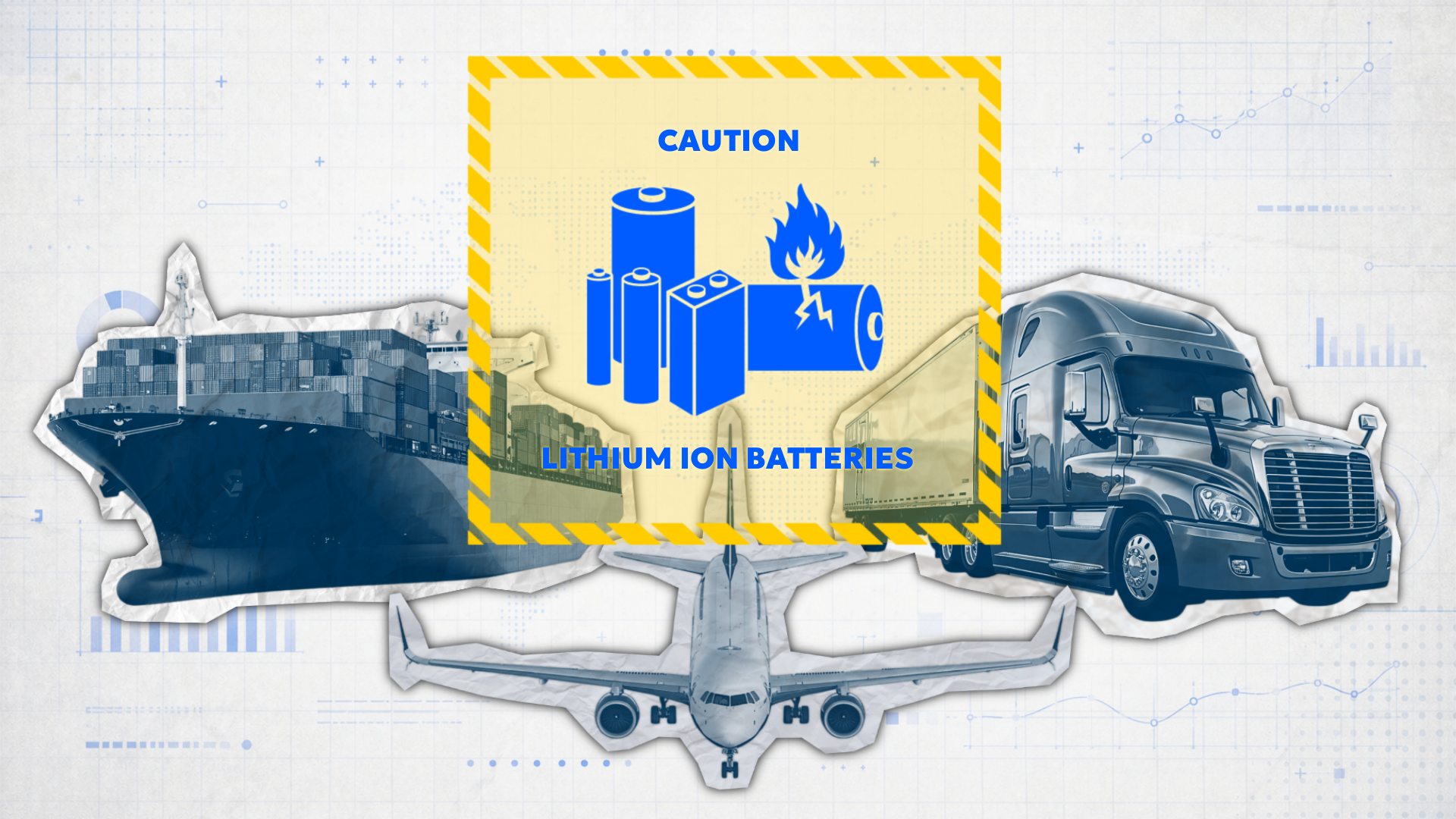
Lithium batteries are Hazmat Class 9 dangerous goods, and the regulations around how they’re transported vary significantly by mode. Air, ocean, and ground shipments each fall under a different regulatory framework with distinct requirements for packaging, documentation, state of charge, and carrier approval.
If you’re moving lithium batteries across any combination of modes, this is your single-source reference for what each one requires.
Quick Reference
How Lithium Batteries Are Classified for Shipping
Before you make any packaging or documentation decisions, you need to know exactly what you’re shipping. The UN classification system distinguishes between four shipment configurations, each with its own UN number, packing instructions, and mode-specific restrictions. Getting this wrong can impact carrier eligibility and whether your shipment can move at all.
Battery shipment configurations break down as follows:
- Standalone lithium-ion batteries – rechargeable cells or battery packs shipped on their own, not installed in or packaged with any device
- Batteries packed with equipment – the battery and device ship together in the same box, but the battery is not installed in the device
- Batteries contained in equipment – the battery is physically installed and operational within the device at time of shipment
- Lithium metal batteries – non-rechargeable cells or packs, shipped standalone or with equipment, subject to stricter restrictions than lithium-ion
Lithium Battery Configurations and Shipping Restrictions by Mode
| Configuration | UN Number | What It Means | Air Restrictions | All-Mode Restrictions |
|---|---|---|---|---|
| Standalone lithium-ion batteries | UN3480 | Battery only – no device included | Prohibited on passenger aircraft; 30% SoC cap | Class 9 labeling; DG declaration required |
| Batteries packed with equipment | UN3481 | Battery and device in the same box; battery not installed | Quantity limits based on watt-hour rating | Class 9 labeling; DG declaration required |
| Batteries contained in equipment | UN3481 | Battery installed and operational in the device | Quantity limits differ from “packed with” configuration | Class 9 labeling; DG declaration required |
| Lithium metal batteries | UN3090 / UN3091 | Non-rechargeable; standalone or with equipment | Prohibited on passenger aircraft in most configurations | Stricter per-package watt-hour limits than lithium-ion; DG declaration required |
The “packed with” vs. “contained in” distinction is important. Both configurations use UN3481, but they follow different packing instructions and quantity limits, and carriers will verify which applies to your shipment.

Shipping Lithium Batteries by Air
Air is the most regulated mode for lithium battery shipments. The governing document is the IATA Dangerous Goods Regulations, which sets the baseline for packaging, labeling, state of charge, and aircraft eligibility. Individual carriers can (and frequently do) impose requirements beyond the IATA floor, so confirming with your carrier before booking is always the right move.
The specific rules that apply to your shipment depend on two things: the UN number of your battery configuration and which IATA section it falls under.
IATA Section IA, IB, and II
IATA organizes lithium battery air shipments into three sections based on cell and battery size, measured in watt-hours (Wh) for lithium-ion and grams of lithium content for lithium metal. The section your shipment falls under determines which aircraft types are permitted, what packing instructions apply, and how many batteries can ship per package.
- Section IA covers lithium-ion cells and batteries that exceed 20Wh per cell or 100Wh per battery. Section IA shipments are restricted to cargo aircraft only and require compliance with Packing Instruction 965 (standalone batteries) or PI 968 (batteries in or with equipment). These shipments also require shipper approval from the operator and carry the most stringent documentation requirements of the three sections.
- Section IB applies to lithium-ion cells between 2.7Wh and 20Wh, and batteries between 20Wh and 100Wh. Section IB shipments can move on both passenger and cargo aircraft, subject to per-package quantity limits. Packing Instructions 965 and 968 apply here as well, under less restrictive conditions than Section IA.
- Section II covers cells and batteries under 2.7Wh per cell and under 20Wh per battery. Section II shipments have the broadest aircraft access and the least restrictive packing requirements, making them the most straightforward category to move by air. Consumer electronics containing small lithium-ion batteries typically fall here.
If your shipment sits near the boundary of any threshold, verify the exact Wh rating of your cells and batteries before assigning a section. Misclassification between IA and IB, in particular, has direct consequences for aircraft eligibility.
The 30% State of Charge Rule
Standalone lithium-ion batteries (UN3480) shipped by air must not exceed 30% of their rated capacity at time of shipment. The rule exists because a fully charged lithium-ion battery generates significantly more heat under pressure – a serious risk in an aircraft cargo hold.
Shipments exceeding 30% SoC are permitted only under Special Provision A331, which requires written approval from both the State of Origin and the State of the Operator. Each authority issues approval independently, and their conditions govern how the shipment moves. A331 exceptions are not routine, so you should engage your freight forwarder early if you anticipate needing one.
Compliance is verified through the shipper’s declaration and UN 38.3 test summary. Incomplete documentation gives carriers grounds to reject the shipment at origin.
Air Freight Packaging and Labeling Requirements
Every lithium battery air shipment must include the following on the outer packaging:
- Class 9 hazmat label
- Lithium battery handling mark displaying the applicable UN number
- Emergency contact number
- Identification of battery type – lithium-ion or lithium metal
Inner packaging requirements:
- Non-metallic material that fully encloses each cell or battery
- Packed to prevent shifting in transit
- Protected against short circuit through individual bagging or non-conductive separation
- Terminals protected at all times
IATA Packing Instruction (PI) 965 applies to standalone UN3480 shipments, while PI 968 covers UN3481 batteries contained in equipment. Confirm which PI governs your shipment with your freight forwarder before booking shipments.

Shipping Lithium Batteries by Ocean
Ocean freight is the most common mode for high-volume lithium battery shipments. The governing framework is the International Maritime Dangerous Goods Code (IMDG Code), published by the International Maritime Organization.
Unlike air freight, ocean shipments are not subject to a state of charge cap. However, documentation and declaration requirements are strict, and non-compliance can result in shipment rejection at port or significant delays through customs.
Key requirements for ocean shipments:
- Declaration: The shipper must accurately declare battery type, UN number, quantity, and classification details. Misdeclaration is one of the most common causes of port rejection.
- Container requirements: Containers must meet IMDG Code specifications, which may include ventilation and segregation from incompatible cargo depending on battery type and quantity.
- Documentation: A dangerous goods declaration and packing certificate are required for every shipment. The UN 38.3 test summary must be available on request.
Partnering with a freight forwarder experienced in IMDG compliance is the most reliable way to ensure your documentation is complete before the container is loaded.
Ocean Freight Packaging and Labeling Requirements
Outer packaging must include:
- Class 9 hazmat label
- UN number marking
- Shipper and consignee name and address
- Emergency contact number
- Battery type identification – lithium-ion or lithium metal
Inner packaging requirements mirror those for air freight. Each cell or battery must be fully enclosed in non-metallic material, protected against short circuit, and packed to prevent shifting in transit.

Shipping Lithium Batteries by Ground
Ground transport of lithium batteries in the United States is governed by Title 49 of the Code of Federal Regulations (49 CFR), enforced by the Department of Transportation’s Pipeline and Hazardous Materials Safety Administration (PHMSA). The core requirements under 49 CFR §173.185:
- Batteries must be protected against short circuit and packaged to prevent damage
- Inner packaging must fully enclose each cell or battery in non-metallic material
- Outer packaging must display the Class 9 hazmat label and applicable UN number
- Shipments meeting certain quantity thresholds require DOT placards on the exterior of the transport vehicle
- A shipping paper describing the hazardous material must accompany every shipment
- Defective, damaged, or recalled batteries may not be transported without a special permit
State-level regulations may impose additional requirements beyond 49 CFR. Confirm with your carrier to ensure smooth transit across state lines.
Lithium Battery Shipping Requirements by Transport Mode
Air, ocean, and ground shipments each answer to a different regulatory body, and the requirements don’t translate directly between modes. Before you move lithium batteries across any combination of modes, you need to know exactly where the rules diverge.
| Air | Ocean | Ground | |
|---|---|---|---|
| Governing body | IATA / ICAO | IMO | DOT/PHMSA |
| Standalone batteries (UN3480) | Cargo aircraft only; 30% SoC max | Permitted with declaration | Permitted; placarding required |
| Batteries in equipment (UN3481) | Passenger + cargo; quantity limits apply | Permitted with documentation | Permitted; DOT packaging rules |
| State of charge requirement | 30% max (UN3480); exceptions require state authority approval | No SoC cap | No SoC cap |
| Packaging standard | IATA Packing Instructions 965–970 | IMDG Code 3.3 SP310 | 49 CFR §173.185 |
| Labeling | Class 9 + lithium battery mark | Class 9 + IMDG markings | DOT Class 9 label + placards |
| Documentation | DG declaration + test summary | DG declaration + IMDG manifest | Shipping papers per 49 CFR |
| Defective/damaged batteries | Prohibited on aircraft | Requires special permit | Prohibited without special permit |
UN 38.3 Testing Requirements
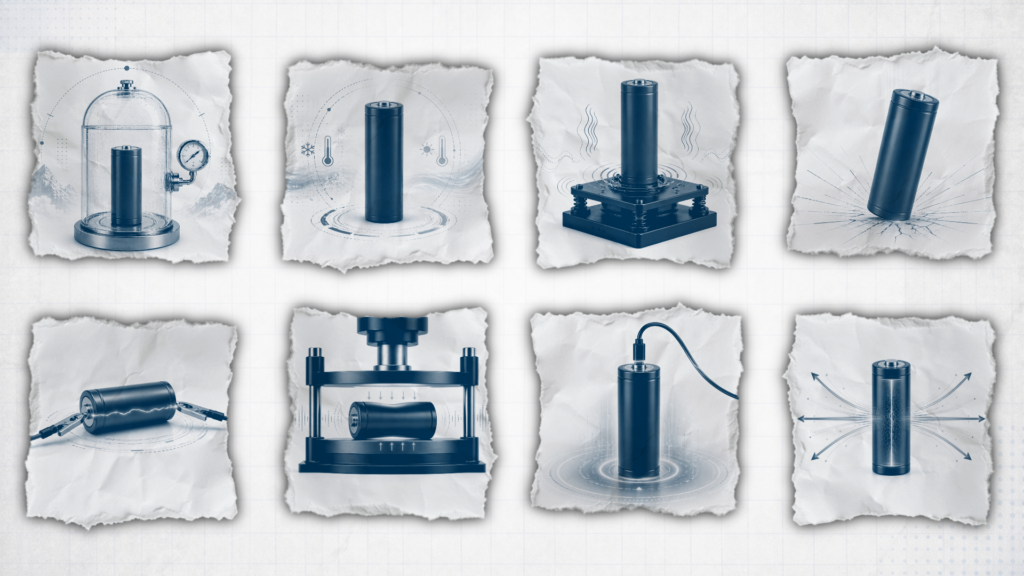
Any lithium battery being transported must have passed UN 38.3 testing. This is the international standard that certifies a battery is safe for transport, and it applies to both standalone batteries and those integrated into devices. Eight individual tests make up the standard, each targeting a specific failure risk during transit.
- T1 Altitude Simulation: Replicates low-pressure conditions at high altitude. Confirms the battery won’t leak or rupture when air pressure drops, as it does in an aircraft cargo hold.
- T2 Thermal: Subjects the battery to rapid, extreme temperature fluctuations. Verifies that cell seals and internal electrical connections hold under thermal stress.
- T3 Vibration: Simulates the vibration a battery experiences during transport. Checks for internal damage or performance degradation from sustained movement.
- T4 Shock: Measures resilience against cumulative mechanical impact. Confirms the battery can withstand the shocks typical of loading, unloading, and transit without failure.
- T5 External Short Circuit: Replicates an external short-circuit event. Verifies the battery doesn’t overheat or catch fire when terminals are inadvertently connected.
- T6 Impact/Crush: Simulates physical abuse from dropping or crushing. Tests whether mechanical damage triggers an internal short circuit.
- T7 Overcharge: Applies to rechargeable batteries only. Confirms the battery can tolerate overcharging conditions without venting, leaking, or igniting.
T8 Forced Discharge: Pushes the battery into forced discharge beyond its rated capacity. Verifies it can withstand the condition without failure.
The Test Summary Requirement
Manufacturers, distributors, and shippers must have a UN 38.3 test summary on file for every lithium battery in their supply chain. The document must include:
- Battery identification, including make, model, and cell chemistry
- Test facility name and contact information
- Pass/fail results for all eight tests
- The UN Manual edition used for testing
- Any applicable deviations or exceptions
Testing must be conducted by an accredited third-party laboratory. Self-certification is not accepted. Request the test summary from your manufacturer before the first shipment moves, since missing documentation gives carriers grounds to reject at origin.
Shipping Defective, Damaged, or Recalled (DDR) Lithium Batteries
Defective, damaged, or recalled (DDR) lithium batteries are subject to stricter rules than standard shipments across every mode. In some cases, they can’t move at all without special authorization.
- Air: DDR batteries are prohibited on both passenger and cargo aircraft without explicit carrier and regulatory approval. In most cases, approval is not granted.
- Ocean: DDR batteries require special permits and must be declared accurately. Misdeclaring a DDR battery as standard is a serious compliance violation.
- Ground: Transport is prohibited without a special permit issued by PHMSA. Standard packaging and documentation requirements do not apply.
Physical damage, swelling, heat exposure, or recall notice from the manufacturer all trigger DDR classification. When in doubt, treat the battery as DDR and consult your freight forwarder before trying to ship.
Getting Lithium Battery Shipments Right
One wrong UN number, a missing test summary, or a documentation mistake can ground your battery shipment before it even leaves the warehouse. The rules across air, ocean, and ground don’t leave much room for error.Dedola’s freight forwarding team has decades of experience navigating complex and evolving shipping requirements. Connect with us to manage your lithium battery shipments from classification through delivery.
FAQs
Can lithium batteries ship on passenger aircraft?
It depends on the configuration. Standalone lithium-ion batteries (UN3480) are prohibited on passenger aircraft entirely. Batteries packed with or contained in equipment (UN3481) can move on passenger aircraft, subject to quantity and watt-hour limits based on IATA section classification.
What happens if my lithium battery shipment is rejected?
Rejection at origin means the shipment doesn’t move until the issue is resolved – whether that’s corrected documentation, repackaging, or reclassification. Rejection mid-transit is more disruptive and can result in the shipment being offloaded and held at an intermediate point. Either way, the cost and delay fall on the shipper.
Do I need a UN 38.3 test summary if I’m not the manufacturer?
Yes. The requirement applies to manufacturers, distributors, and shippers. If you’re sourcing batteries from a manufacturer, request the test summary before your first shipment moves. You are responsible for having it available if a carrier or customs authority asks for it.
Are there quantity limits for lithium batteries shipped by ground?
Unlike air freight, ground transport under 49 CFR does not impose the same per-package quantity limits based on watt-hour rating. However, shipments exceeding certain thresholds trigger additional requirements including DOT placarding on the transport vehicle and detailed shipping papers. Large-volume ground shipments should be reviewed with your freight forwarder to confirm applicable requirements.