
Musical instrument shipping is one of the more demanding freight categories in international trade. The cargo is physically sensitive, regulatory requirements are complex, and the consequences of getting it wrong are often difficult to correct. For importers and distributors, that combination makes preparation the most important part of the process.
What Makes Musical Instrument Shipping So Difficult
Musical instruments are unlike most general freight categories, and the logistics requirements reflect that. The physical sensitivity of the cargo, combined with the regulatory complexity surrounding many instrument materials, means there are multiple points where a shipment can go wrong.
Physical Sensitivity
The materials that make instruments valuable are the same ones that make them vulnerable in transit. Tonewoods, lacquer finishes, glued joints, and precision-wound strings react to conditions that most standard cargo can withstand without issue.
- Wood expands and contracts with temperature and humidity fluctuations, causing structural stress even without physical impact.1
- Even brief exposure to humidity outside acceptable ranges can causewarping or tuning instability in string instruments.2
- Vibration accumulates across long transits and can damage glued joints and delicate components.3
- Finish damage from moisture penetration is rarely reversible.4
Regulated Materials
Many instruments contain materials subject to international trade restrictions, and this is where importers often run into serious delays.
- CITES-controlled woods (rosewood, mahogany, ebony) require documentation under the international treaty governing trade in endangered species.5
- Ivory components, even on antique instruments, carry strict import restrictions in most markets.6
- Lithium batteries in electronic instruments are classified as hazardous materials and require UN 38.3 certification.7
- Understating commercial invoice valuations on high-value instruments is a common trigger for customs scrutiny.8
A single undeclared restricted material can result in seizure at port and delays that take weeks or months to resolve.
Packaging and Routing Decisions
Even when the cargo is properly documented, poor packaging and routing choices introduce risk that documentation can’t fix.
- Generic boxes and insufficient internal bracing leave instruments exposed to vibration and impact across long transits.
- Uncontrolled layovers at intermediate ports are among the highest-risk points in any international instrument shipment.
- Carrier selection and route planning need to account for climate stability across every leg, not just the primary one.
- A reinforced crate built to the instrument’s dimensions provides more protection than a standard shipping box, regardless of interior padding.
These aren’t risks that only apply to rare or antique instruments. They’re present in everyday commercial shipments across every instrument category.
How to Ship Musical Instruments Internationally
Protecting instruments in international transit requires decisions made well before cargo moves. Each of the following areas can carry real consequences if handled poorly.
Packaging and Crating Standards
Packaging requirements vary by instrument type, and a one-size approach introduces unnecessary risk. A violin and a grand piano have almost nothing in common from a crating standpoint, and the same is true across strings, brass, keyboards, and digital audio systems.
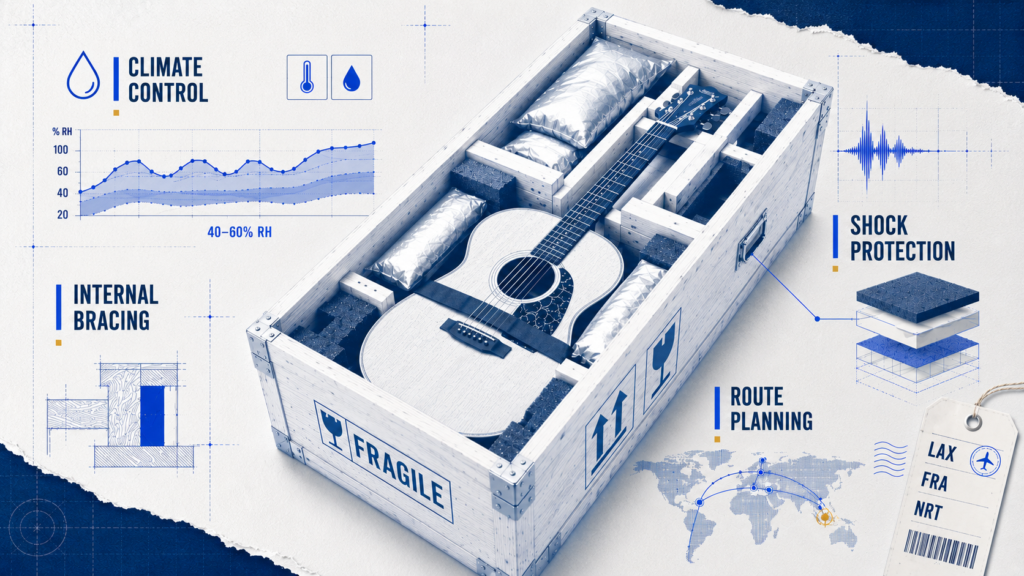
- Outer shells should be reinforced wood or hard-shell crates built to the instrument’s dimensions, not adapted from standard box sizes.
- Vibration-dampening foam or custom inserts should immobilize the instrument inside the crate, eliminating movement without applying pressure to vulnerable components.
- Climate-sealed wraps provide a moisture barrier between the instrument and the outer crate, critical for wood instruments on ocean freight.
- Internal bracing should account for the specific stress points of each instrument type, including necks, bridges, tuning mechanisms, and finish surfaces.
Carrier and Route Selection
Not all carriers handle high-value fragile cargo with the same level of care, and not all routes offer the same level of climate stability. Both factors matter.
- Carriers should be vetted for experience with delicate, high-value freight, not selected on cost or transit time alone.
- Routes should minimize dwell time at uncontrolled intermediate ports, where exposure to temperature and humidity is harder to manage.
- Direct routing reduces the number of handling points, which lowers the cumulative risk of impact damage.
Customs Documentation and Regulated Materials
Documentation errors are easier to prevent than to fix once a shipment is in motion. Getting this right before departure is the only reliable approach.
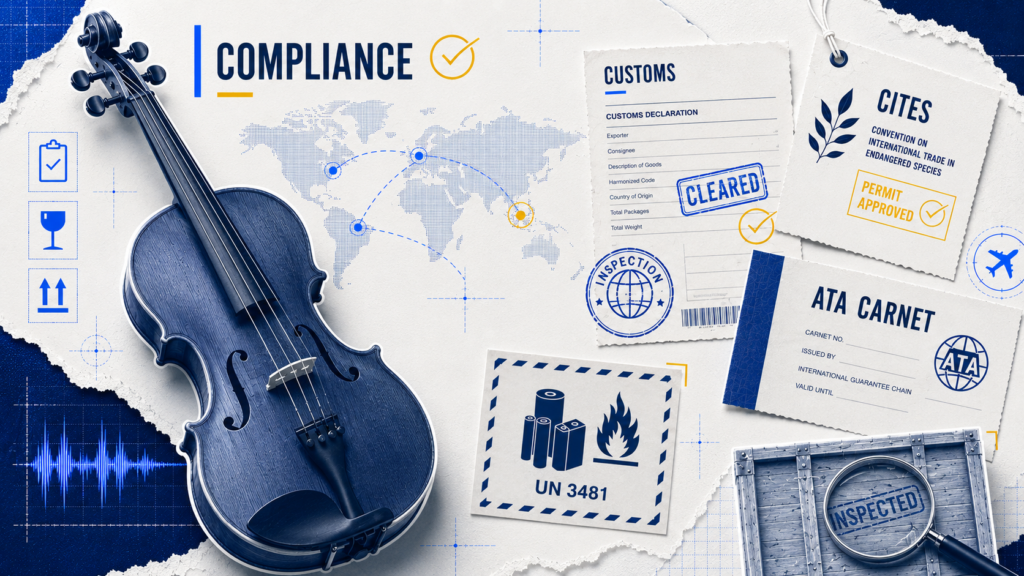
- CITES permits must be obtained in advance for any instrument containing rosewood, mahogany, ebony, or other listed species, and requirements vary by country of import.5
- ATA Carnets allow instruments to cross borders temporarily without paying import duties, making them the standard solution for touring gear and trade show equipment.9
- Commercial invoices must reflect accurate full value, as both undervaluation and overvaluation create customs risk on high-value instruments.8
- Electronic instruments containing lithium batteries require UN 38.3 certification and must be declared as hazardous materials regardless of battery size.7
Insurance and Pre-Shipment Verification
Full-value insurance coverage is a baseline requirement for high-value instrument shipments, and the documentation supporting that coverage is what determines whether a claim can actually be resolved.
- Coverage should reflect the instrument’s current market value, not its original purchase price or a conservative estimate.
- Photo documentation before crating creates a verified baseline condition record that supports any claim made after delivery.
- Post-delivery inspection and documentation closes the loop and provides accountability at the receiving end.
Getting these four areas right before departure doesn’t eliminate every variable in international freight, but it removes the ones that are most likely to cause irreversible damage or costly delays.
How Dedola Approaches High-Value Musical Instrument Shipping
Instrument freight requires a specific kind of expertise. Compliance requirements need to be identified before departure, not discovered at port. Carriers and routes need to be selected with the cargo’s physical sensitivity in mind. Documentation must be accurate for every regulated material in the shipment.
Dedola has managed high-value, fragile cargo for over 50 years. For instrument importers and distributors, that kind of experience means fewer surprises and faster resolution when variables change.Shipping high-value instruments internationally? Reach out to the experts at Dedola to explore how we can help.
FAQs
What’s the best way to pack a guitar for international shipping?
A guitar should be shipped in a hard-shell or reinforced-wood crate built to its dimensions. Key requirements include:
- Vibration-dampening foam or custom inserts that immobilize the instrument without applying pressure to the neck, bridge, or tuning pegs
- A moisture barrier between the instrument and the outer crate, particularly important for ocean freight
- Reinforced outer construction appropriate for international freight handling
Soft cases and standard cardboard boxes are not appropriate for international shipping, regardless of how much padding is added.
What’s the difference between air and ocean freight for musical instrument shipping?
Air freight is faster and generally exposes instruments to fewer climate variables and handling points, although it is usually more expensive. Ocean freight takes longer and introduces more humidity exposure, particularly on long transoceanic routes, but can be appropriate for well-packaged cargo where transit time is flexible. The right choice depends on the instrument type, packaging capability, destination, and timeline.
Which instruments contain CITES-regulated materials?
Many commonly shipped instruments contain CITES-listed species. Examples include:
- Guitars, violins, cellos, and double basses, which frequently incorporate rosewood, mahogany, or ebony5
- Woodwind instruments, many of which use grenadilla or other listed woods
- Antique instruments of almost any category, which may contain ivory6
Requirements vary by country of import, so documentation should be confirmed for each specific destination before the shipment moves.
How long does it take to obtain a CITES permit?
Processing times vary by country of export but typically range from a few days to several weeks.10 Some countries have more streamlined processes than others, and applications require detailed information about the instrument, including species confirmation, quantity, and intended use. Given the potential for delays, CITES permits should be initiated well in advance of the planned shipment date.
Do electronic instruments require special documentation?
Yes. Electronic instruments containing lithium batteries are classified as hazardous materials and require UN 38.3 certification before they can move via most international carriers.7 This applies to keyboards, digital pianos, electronic drum kits, and any instrument with a built-in battery system.
Sources
- Rhythm Music Shop — “Tips for Maintaining Wooden Instruments in Different Climates”
- MusicNomad Equipment Care — “The Complete Guide to Guitar Humidity”
- Music & Arts / The Vault — “Why Band Instruments Are Sensitive to Temperature”
- Eureka Dry Tech — “Humidity/Moisture Damage and Wooden Instruments”
- Taylor Guitars — “CITES Rosewood Trade Regulations”
- U.S. Fish & Wildlife Service — “Elephant Ivory FAQs”
- IATA — “Lithium Batteries (Dangerous Goods)”
- U.S. Customs and Border Protection — “Trade Violations”
- International Chamber of Commerce — “ATA Carnet Solution”
- U.S. Fish & Wildlife Service — “FAQs About International Affairs’ Permits”