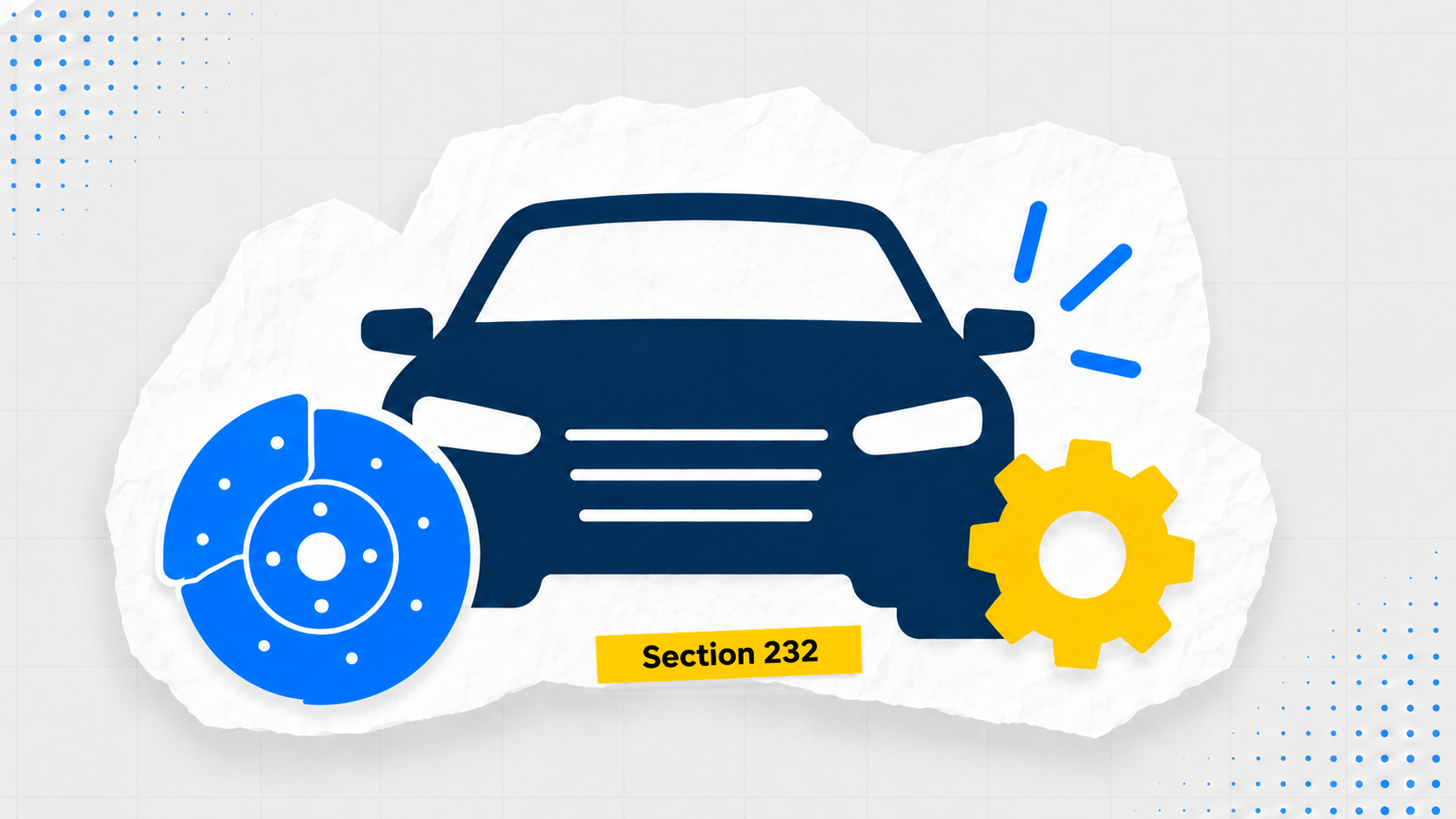
Section 232 added a 25% tariff on covered auto parts in 2025, and most importers assume the rate is fixed by what the part is or where it came from. It isn’t. The rate depends on how the part is classified and what documentation supports that classification.
That distinction matters more now than it did a year ago.
- A new Section 301 action, separate from the Section 301 tariffs that have applied to Chinese-origin goods since 2018, added a forced-labor duty in 2026.
- Section 338 followed shortly after.
- Each treats classification and origin documentation differently, so paperwork that protects a shipment under one rule doesn’t necessarily protect it under another.
This blog explores how tariffs affect auto parts and what importers can do to avoid overpaying.
Quick Reference
Section 232 Tariffs on Auto Parts: What’s Covered

Section 232’s 25% tariff doesn’t apply to “auto parts” as a category. It applies to a defined list of HTS headings:
- Engines and engine parts: HTS 8407, 8408, and 8409
- Vehicle bodies and chassis: HTS 8706 and 8707
- General parts and accessories: HTS 8708, covering bumpers, brakes, gearboxes, axles, wheels, suspension components, radiators, exhaust systems, clutches, steering components, and airbags
- Passenger vehicle tires: HTS 4011.10 only
- Electrical components: HTS 8511.40 and 8511.50 (starters and alternators), plus select HTS 8501 electric vehicle traction motors
A part outside these headings, an aftermarket trim piece or a non-drivetrain accessory, for example, isn’t automatically subject to the 232 rate. Whether a given SKU falls inside or outside the list comes down to the HTS subheading assigned to it, not a general description of what the part does. Two components that look nearly identical on a packing list can land in different tariff categories depending on how they’re coded.
The 25% stacks on top of your existing duty rate. It doesn’t replace it.
- Most HTS 8708 parts already carry a base Most Favored Nation duty rate between 0% and 4%.
- Brake components under HTS 8708.30, for example, carry a 2.5% MFN rate on their own.
Section 232 adds to that. For example:
| Shipment | Base MFN duty | Section 232 | Combined |
|---|---|---|---|
| $50,000 of brake components (HTS 8708.30) | $1,250 (2.5%) | $12,500 (25%) | $13,750 (27.5%) |
Importers who budget for the 25% and forget the base rate underneath it will underestimate their real landed cost.
It is important to note that duty-drawback doesn’t apply. Drawback is the process of recovering duties paid on goods that are later re-exported. Section 232 tariffs are excluded from it, so an incorrect classification isn’t a cost you can recover later.
Three Factors That Determine Your Auto Parts Tariff Rate

1. HTS classification
The HTS subheading you assign determines whether Section 232 applies to a part.
- Get the subheading wrong, and you either pay a tariff you didn’t owe or miss one you did.
- When a classification is genuinely unclear, CBP will issue a binding ruling: a written determination that locks in the correct code for that part on future entries.
- If you’re unsure, request one before the part ships.
- Once CBP has ruled, that ruling becomes the record on file and stays binding as long as the imported part matches the facts described in the request.
- Your freight forwarder can request a binding ruling on your behalf and help you flag which parts in your catalog carry enough classification risk to justify one.
2. Country of origin versus country of assembly
USMCA exempts qualifying auto parts from the 25% Section 232 tariff, and qualifying requires more than simply assembling the part in Mexico or Canada.
- USMCA requires the part to meet the rule of origin that applies to its classification, which can involve a Regional Value Content (RVC) threshold, a tariff-shift requirement, or both, depending on the part.
- RVC measures how much of the part’s value originates in the US, Canada, or Mexico.
- A part assembled in Mexico from components sourced in Asia can fail that threshold even though the finished part carries a Mexican assembly stamp, and a part that fails it, doesn’t get the exemption.
That distinction is about to carry even more weight: the tariff actions Canada is facing in 2026 don’t all extend the same exemption Section 232 does.
3. Regional Value Content documentation
Meeting the Regional Value Content threshold is only half of it.
- You also need the paperwork that proves it, typically a certification or calculation worksheet showing how the percentage was reached, usually prepared by the supplier and confirmed by the importer of record.
- If your supplier can’t produce an RVC certification on request, treat that as a signal to verify the exemption before you rely on it.
Section 301 and Section 338: What’s Changing for Canadian-Sourced Parts

If your parts come from Canada, Section 232 isn’t the only tariff action to track anymore. Two more recently took effect, and they don’t follow the same rules.
Section 301 added a forced-labor enforcement duty on imports from a list of countries that includes Canada and Mexico, an additional 10% on top of existing rates. It exempts two categories:
- Goods already subject to the Section 232 tariff.
- Goods that qualify for the USMCA exemption.
So the same HTS classification that puts a part under Section 232, or the same RVC documentation that qualifies it for USMCA, is also what shields it from Section 301 tariffs.
Section 338 works differently.
- It added a 50% tariff on a narrow set of Canadian goods, and it carries no USMCA exemption.
- Auto parts already covered under Section 232 are excluded from it, so a correctly classified part doesn’t pick up Section 338 on top of the 25% it already carries.
That exclusion depends on the same thing everything else in this piece does: whether the part’s classification is on file and accurate before the question comes up.
Is Your Auto Parts Import Process Ready for Section 232?
A few questions worth answering before your next shipment books:
- Do you know the HTS subheading for each SKU you import, and whether it falls inside the Section 232 covered list?
- If your parts are assembled in Mexico or Canada, do you have Regional Value Content documentation on file, not just a country-of-origin statement?
- Have you gotten a binding ruling from CBP for parts where classification is ambiguous, or are you relying on a supplier’s word?
- Do you know whether your Canadian-sourced goods fall under Section 301, Section 338, or Section 232, and which exemptions actually apply to each?
- If CBP asked you tomorrow to produce your RVC calculation on a shipment from six months ago, could you find it today?
If any of those questions gave you pause, that’s not surprising. Three separate tariff actions have applied to auto parts since last year, and keeping up with them can feel like a job unto itself.
How Dedola Global Logistics Helps
At Dedola Global Logistics, we help auto parts importers stay ahead of the latest tariff changes and requirements. We review your HTS classifications and Regional Value Content documentation against the current Section 232, 301, and 338 rules, and flag where a binding ruling or updated paperwork would protect you. When a new proclamation changes an exemption, we tell you which of your shipments are affected and coordinate directly with your customs broker.
Dedola has 50 years of logistics experience, with specific expertise in auto parts import compliance. Talk to our team about a classification and compliance review before you book your next shipment.
FAQs
What is the Section 232 tariff on auto parts, and which parts does it apply to?
The Section 232 tariff on auto parts is a 25% duty, added in 2025, that applies only to a defined list of HTS-classified components rather than to auto parts as a general category. Covered categories include: ● Engines and engine parts (HTS 8407, 8408, and 8409) ● Vehicle bodies and chassis (HTS 8706 and 8707) ● General parts and accessories under HTS 8708, including bumpers, brakes, gearboxes, axles, wheels, suspension components, radiators, exhaust systems, clutches, steering components, and airbags ● Passenger vehicle tires (HTS 4011.10 only) ● Electrical components under HTS 8511.40 and 8511.50 (starters and alternators), plus select HTS 8501 electric vehicle traction motors Whether a specific part falls on this list depends on its HTS subheading, not a general description of what it does.
How do I know if my auto parts qualify for the USMCA exemption?
Your auto parts qualify for the USMCA exemption when they meet the rule of origin that applies to their classification, not simply because final assembly happened in Mexico or Canada. ● That rule can involve a Regional Value Content (RVC) threshold, meaning a defined percentage of the part’s value originates in the US, Canada, or Mexico, a tariff-shift requirement, or both, depending on the part. ● Whichever applies, it has to be documented, typically through a supplier certification or worksheet, and without that documentation on file, treat the exemption as unconfirmed.
What is a binding ruling, and how long does it typically take to get one back from CBP?
A binding ruling is a written determination from CBP that locks in the correct HTS classification for a specific part on future entries, so the classification isn’t left to guesswork or a supplier’s word. ● CBP typically issues one within 30 calendar days of a complete request. ● That timeline can stretch to 60 or 90 days if the part requires lab testing or review by another federal agency, so request one well before you need the shipment to move.
Are used or refurbished auto parts classified the same way as new ones?
Often, but not always. ● Used and refurbished auto parts are generally classified under the same HTS headings as new ones, since classification is based on what the part is rather than its condition. ● Remanufacturing or a change in condition can still affect the classification, valuation, or regulatory requirements that apply, and components like engines or transmissions can trigger additional EPA or safety paperwork that a new part wouldn’t need.
If my parts don’t qualify for the USMCA exemption, is there anything else that can reduce what I owe?
If your parts don’t qualify for the USMCA exemption, two other levers are worth considering. ● Using the first sale price in a multi-tiered transaction can lower the value the tariff is calculated against, which does reduce what you owe. ● Importing through a foreign trade zone can defer payment and improve cash flow, but it doesn’t reduce the Section 232 duty itself. Duty drawback isn’t an option either, since Section 232 tariffs are excluded from it, so it’s also worth double-checking that the part is actually covered under Section 232 in the first place.
Sources
- Federal Register: “Adjusting Imports of Automobiles and Automobile Parts Into the United States”
- Congressional Research Service: “USMCA: Automotive Rules of Origin”
- U.S. Customs & Border Protection: “USMCA Fact Sheet: Regional Value Content”
- Federal Register: “Notice of Actions in Section 301 Investigations… Related to the Failure… To Impose and Effectively Enforce a Prohibition on the Importation of Goods Produced With Forced Labor”
- Federal Register: “Imposing Additional Duties To Offset Canadian Discrimination Against the Commerce of the United States With Respect to Motor Vehicles”