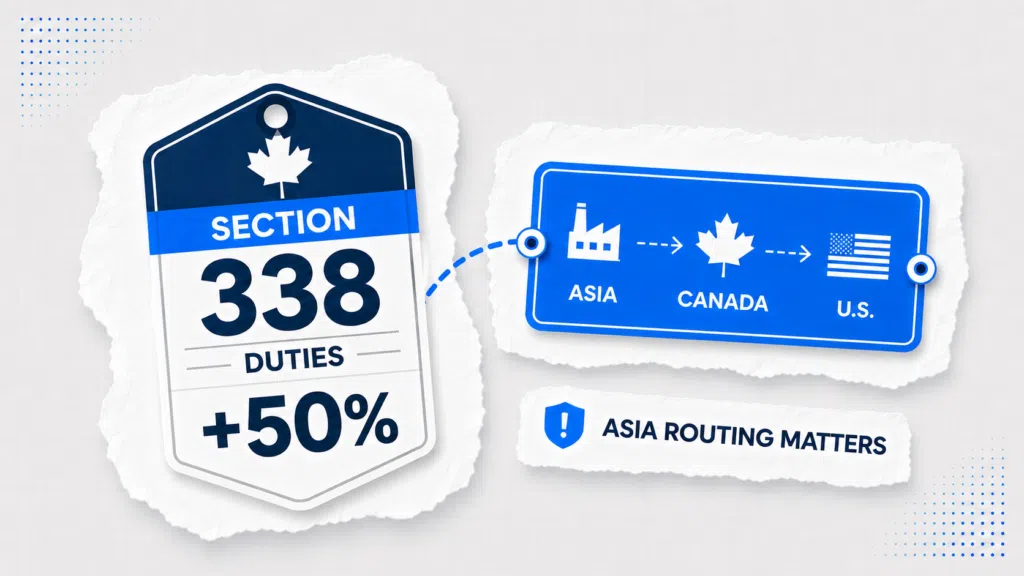
Section 338 tariffs on Canadian goods jumped to 50% this week, and Canada has already responded with its own set of retaliatory duties. Below is a breakdown of what’s happening and, more importantly, why it’s worth watching even if you don’t import directly from Canada.
Quick Reference
The New Section 338 Tariffs on Canada

CBP has issued updated guidance on new Section 338 tariffs affecting Canadian imports. These additional 50% duties went into effect on August 22, 2026, for covered goods entered for consumption, or withdrawn from warehouse for consumption, on or after that time.
The 50% rate applies broadly to articles of aluminum, steel, and copper, along with derivative products in those categories.2,3,4 A separate group of goods, including passenger vehicles, light trucks, medium and heavy duty vehicles and their parts, wood products, semiconductor articles, and patented pharmaceuticals, is also covered under the new Chapter 99 headings but carries a 0% additional rate. Civil aircraft, engines, parts, and ground flight simulators are likewise covered but also sit at 0%.
One detail worth flagging: there is no USMCA exemption here. Goods that would normally clear duty-free under the agreement are still subject to these additional duties if they fall into a covered category. The additional duty under a few headings is subject to drawback, so confirm with your broker whether it applies to your goods.
Action items:
- Confirm which of your Canadian-origin HTS classifications fall under the new Chapter 99 headings.
- Don’t assume USMCA eligibility protects you here. It doesn’t.
- Check with your broker on drawback eligibility if your goods fall under an applicable heading.
Canada’s Retaliatory Tariffs

Canada has already responded. Starting September 8, Canada will impose tariffs ranging from 15% to 50% on more than 700 American products, covering roughly $20 billion worth of U.S. goods. The most significant piece doubles Canada’s tariffs on American steel and aluminum to 50%.
The list extends well beyond metals, covering wood and paper products, appliances, agricultural equipment, dairy, seafood, clothing, tools, and electronics. If your business ships any of these categories across the border in either direction, it’s worth reviewing the full list once Canada publishes it.
Why This Matters Even If You Don’t Import From Canada
If you don’t import from Canada directly, it’s easy to read the above and assume it doesn’t apply to you. It might, though, even if indirectly.
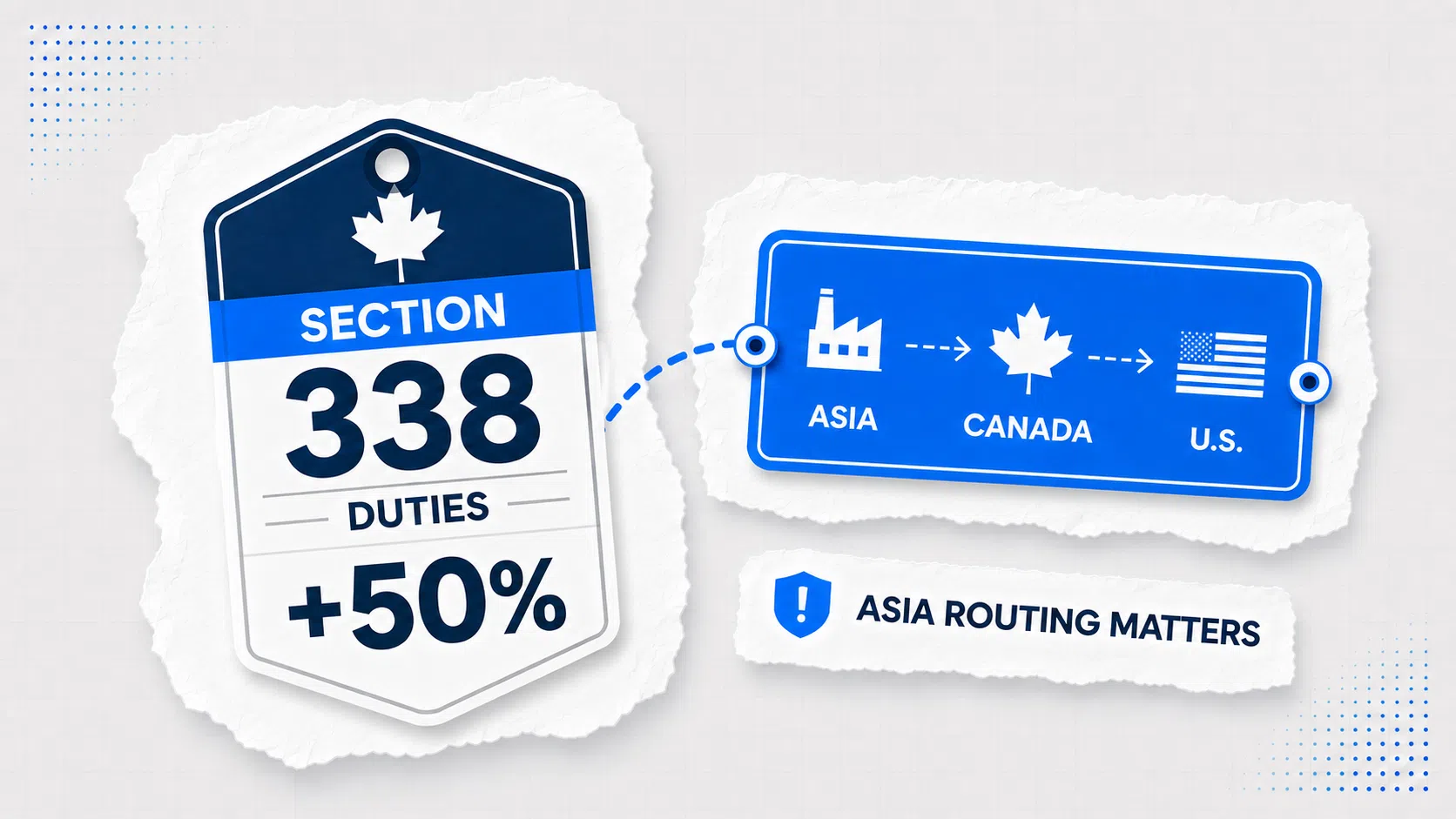
Canada has long served as a transit and light-processing point for goods that originate in Asia before entering the U.S. market. As tariffs climb on both sides, U.S. Customs has more incentive than ever to scrutinize that routing closely. A product manufactured or sourced in China or elsewhere in Asia doesn’t lose its origin just because it passed through a Canadian port or warehouse. Tariff engineering rules require substantial transformation of a product to qualify for a new origin status, and CBP has long treated Canada as a potential backdoor for goods trying to avoid direct U.S. tariffs.
In practical terms, that means more scrutiny on origin documentation for goods that pass through Canada, even briefly, and more volatility on that route generally. If Canada has ever been part of your routing, even as a processing point rather than a true origin, now is a good time to confirm your documentation supports the origin claim you’re making.
Navigating the Next Steps
Tariff changes like these move fast, and it’s easy to lose track of which ones actually apply to your goods. That’s the part of the job we handle for our clients every day. We’ve been helping importers navigate shifts like this for over 50 years, and we’re happy to look at your specific product lines and routing if you have questions about how these changes affect you. Reach out to us anytime.
Sources
- U.S. Customs and Border Protection – CSMS #69606660: GUIDANCE: Section 338 Additional Duties on Certain Goods of Canada
- Federal Register – Imposing Additional Duties To Offset Canadian Discrimination Against the Commerce of the United States With Respect to Alcoholic Beverages (Proclamation 11046)
- Federal Register – Imposing Additional Duties To Offset Canadian Discrimination Against the Commerce of the United States With Respect to Dairy (Proclamation 11047)
- Federal Register – Imposing Additional Duties To Offset Canadian Discrimination Against the Commerce of the United States With Respect to Motor Vehicles (Proclamation 11048)
- The Washington Post – Canada announces retaliatory tariffs on U.S. products as trade war deepens