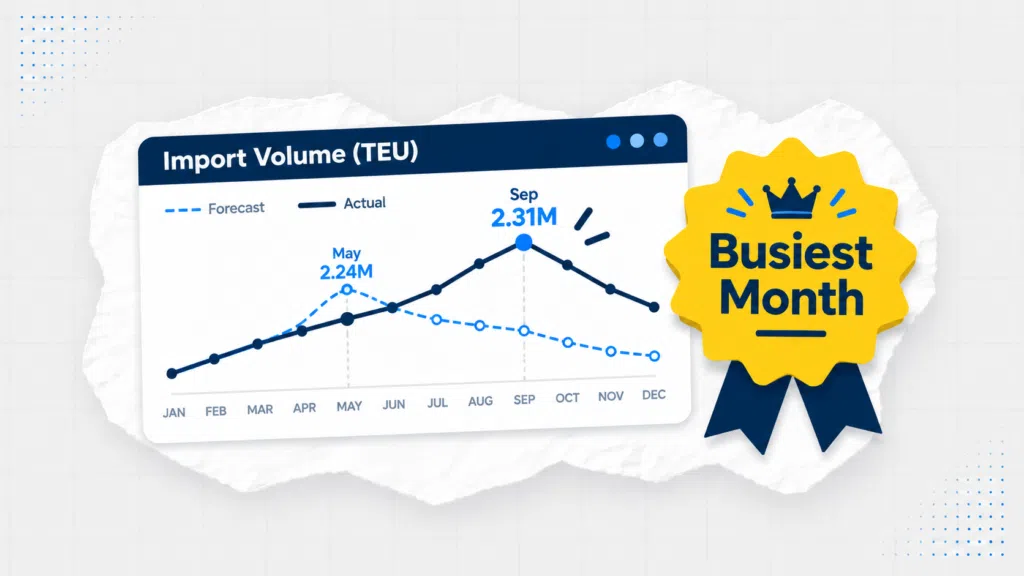
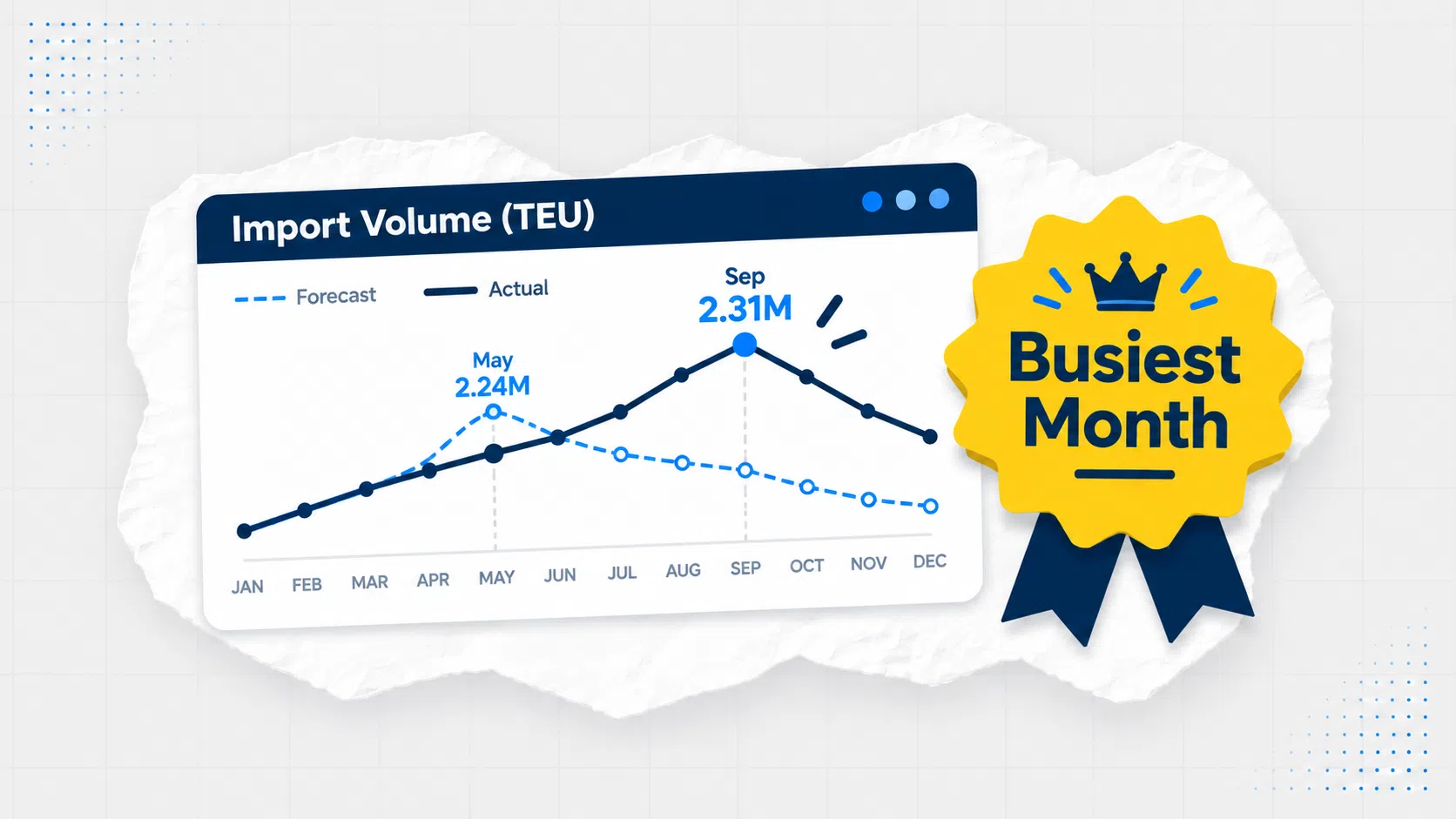
U.S. ports are on track to handle 2.31 million TEU this September, up 9.6% from a year ago, which would make it the busiest import month of 2026. Most forecasts called for the peak to be mostly behind us by now. It isn’t. Here’s what changed, and what it means if you’re shipping freight in Q4.
Quick Reference
Why September Is the Busiest Import Month of 2026

Earlier this year, most analysts expected May to be the biggest month for 2026 imports. Retailers had accelerated shipments aggressively in the first half of the year, pulling orders forward to get ahead of potential tariff increases. May volumes reflected that with 2.24 million TEU, up 14.9% from May 2025.¹
September has come in even higher. The National Retail Federation’s Global Port Tracker report, released September 9, projects U.S. container ports will handle 2.31 million TEU this month, a 9.6% increase year-over-year and slightly above July’s 2.30 million TEU.¹ That makes September not just the peak of the summer shipping season, but the busiest single import month of the year so far.
The Port of Los Angeles adds further context. The port processed nearly 2.9 million TEU across June, July, and August combined, its busiest summer quarter on record and a figure that surpasses even pandemic-era import surges.² August alone came in at 955,907 TEU, the highest August total the port has ever recorded. Port officials attributed the volume to early arrivals of Halloween, Thanksgiving, and Christmas holiday merchandise.
Of course, with all this volume pumping into West Coast ports, the transpacific lanes you’re looking at for Q4 bookings are already operating at or near peak capacity. Securing space is more challenging than it typically would be this time of year, and market rates have increased in response.
What Pushed the Peak This Late Into the Year

The conventional read on 2026 was that front-loading in Q1 and Q2 would pull the peak forward and leave the second half of the year quieter than usual. That appears to be half right.
Front-loading created early supply, but it didn’t reduce consumers’ underlying demand for goods. NRF Vice President of Supply Chain and Customs Policy Jonathan Gold confirmed: despite rising tariffs, inflation, and high fuel costs, “consumers keep buying… and retailers keep bringing in merchandise to meet demand.”¹ Once first-wave inventory moved through distribution, retailers placed replenishment orders, and that second wave is what’s driving September’s numbers now.
Two operational factors accelerated the dynamic. First, severe weather in China caused vessel delays that pushed expected summer arrivals later, compressing what should have spread across July and August into a single congested month. Second, drought conditions at the Panama Canal forced rerouting away from that lane, adding transit time across transpacific shipments and delaying cargo that was already running behind schedule.
The result is a peak season that’s longer and flatter than the short, sharp surge most importers plan for, and the one we’re still witnessing well into September.
Action items:
- Don’t use last year’s transit times to plan your Q4 arrival dates. Current vessel schedule reliability on transpacific lanes reflects weather delays and Panama Canal rerouting that weren’t factors in 2025. Get current estimated departure dates from your freight forwarder before you commit to any arrival window.
- If your goods move through the Panama Canal, confirm your freight forwarder has a routing contingency ready. Not just a backup they’d consider if things went wrong. An actual contingency with confirmed rates and transit times on an alternative lane.
- If you placed replenishment orders after your spring shipments landed, treat those bookings as peak-season freight. Because that’s what they’re competing against right now.
What Q4 Volume Looks Like From Here
Volume will come down from September’s peak, but gradually. The NRF projects:
- September: 2.31 million TEU
- October: 2.11 million TEU (+1.7% year-over-year)
- November: 2.00 million (-0.9%)
- December: 2.03 million (+1.1%)
- Full-year 2026: 25.7 million TEU
A gradual decline is not the same as relief. October in particular offers less breathing room than the volume numbers imply. Carriers use blank sailings to manage capacity during volume transitions, and a single missed sailing can push a delivery past your window. If you’re booking for an early November arrival and your vessel gets blanked, your goods are now looking at a mid-to-late November arrival at best. For time-sensitive holiday goods, that’s an issue you likely can’t afford.
In addition to ocean freight concerns, inland transport rates are on the rise. Retail diesel has crossed $6 per gallon,³ and trucking surcharges are rising in response. Drayage from port to your distribution center or warehouse costs more today than it did 60 days ago. If you haven’t rerun your total landed cost calculations since mid-summer, your margin projections are likely off.
What to Do Before You Book Your Next Q4 Shipment
Getting Q4 right this year means questioning assumptions from last year. Run through this checklist before booking to help ensure things go as planned.
- Recheck vessel schedule reliability on your lanes before relying on an arrival date. Published schedules don’t capture the delays currently impacting carrier performance. Your freight forwarder should be able to give you a realistic picture of what’s happening on your specific origin-to-destination pairs right now.
- Confirm your freight forwarder has a routing contingency for the Panama Canal. If your goods originate in Asia and move to U.S. East Coast or Gulf ports, ask directly: what does the alternative routing look like, what does it cost, and how much transit time does it add? You should understand your options ahead of time.
- Get your drayage costs requoted against current diesel surcharge rates. Fuel surcharges move with the diesel index. A rate sheet from July isn’t a reliable model for today’s costs. A quick requote now prevents an unwelcome surprise on your invoice later.
- Verify your cargo insurance covers rerouted itineraries. If your shipment ends up on a different vessel or through a different port than originally booked, your cargo insurance policy needs to cover the new routing. Confirm this with your broker before your goods are in motion.
- Ask your freight forwarder specifically about blank sailing risk through October before you finalize your bookings. Knowing which services on your lane are at risk lets you build a realistic buffer into your schedule. A two-week buffer on a December delivery is manageable. Discovering a blank sailing three weeks before your target arrival date is not.
The importers most likely to come out of Q4 in good shape aren’t guessing. They’re working with freight forwarders who’ve navigated extended peaks before and know where things go wrong. Dedola has been helping importers navigate peaks like this for over 50 years, and we’re here to help. If you want a knowledgable review of your specific lanes and Q4 shipping needs, reach out to our team.
FAQs
Is the 2026 peak season over?
Likely, no. September is on track to be the busiest import month of 2026, surpassing May’s tariff-driven surge. Volume will taper through Q4, but the transpacific lanes carrying holiday freight are still operating at near-peak capacity through at least October.
Why is September busier than May if retailers already front-loaded shipments earlier this year?
Front-loading created early supply. It didn’t reduce demand. Once first-wave inventory moved through distribution, retailers placed replenishment orders. That second wave, combined with vessel delays from weather in China and Panama Canal rerouting, is what’s driving September’s volumes.
How does Panama Canal rerouting affect my shipment if I’m importing to the East Coast?
If your goods originate in Asia and move to U.S. East Coast or Gulf ports via the Panama Canal, drought-related draft restrictions have pushed some carriers to reroute. That adds transit time, changes your vessel options, and in some cases changes which ports your goods arrive at. Confirm your routing and any contingency plans directly with your freight forwarder before you finalize bookings.
Should I be looking at air freight for goods that need to arrive by December?
It depends on your margin and how large your timing gap is. Air freight removes you from the current ocean congestion picture entirely, but at a significantly higher cost per unit. For high-value, time-sensitive goods where a missed holiday window costs more than the air premium, it’s worth running the numbers. For volume freight, the math rarely works. Talk to your freight forwarder about the specific gap you’re trying to close before making that call.
Sources
- National Retail Federation / Hackett Associates, Global Port Tracker Report, September 9, 2026
- Port of Los Angeles, Monthly Volume Report, August 2026
- Journal of Commerce, “Spiking US Diesel Prices Increase Surcharges, Truck Bankruptcy Risk”