 Corina Meono
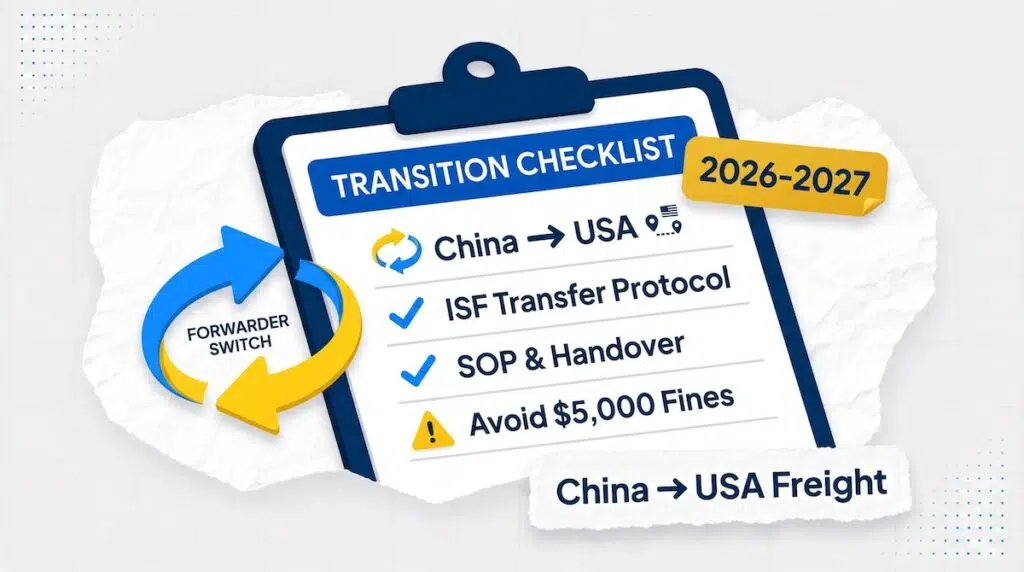
CBP can assess $5,000 per violation for a late or inaccurate Importer Security Filing (ISF), the first risk to control when you switch freight forwarders on China-to-USA shipments. Most other risks sit in the handover: open house bills, unreleased containers, and demurrage clocks still running at Los Angeles and Long Beach. A controlled transition keeps in-transit cargo with the incumbent, moves new bookings to the new forwarder, and confirms bond and power of attorney status first.
This guide provides a detailed standard operating procedure (SOP), the ISF-10 transfer protocol, the documents to collect, and a transition checklist for 2026 and 2027.
In this guide
Quick answers
Can I switch freight forwarders while my cargo is already on the water?
Yes, but the incumbent should normally finish any shipment already on the water. The Federal Maritime Commission licenses NVOCCs to issue house bills of lading, and the issuing NVOCC controls release against that bill, so moving in-transit cargo means the incumbent must amend or surrender its bill. For an easier transition, switch forwarders at the next booking instead.
What happens to my ISF filing and continuous customs bond when switching forwarders?
An ISF already accepted in CBP’s ACE system stays with the party that filed it, and under 19 CFR Part 149 it is due 24 hours before lading abroad, so the incumbent should keep amending open filings. CBP treats the importer as the continuous bond principal. Confirm ISF coverage and update the customs power of attorney.
What documents do I need to collect from my incumbent forwarder before issuing a termination notice?
Collect an open-shipment list with house and master bill numbers, container numbers, and ETAs. Request ISF transaction numbers, entry summaries (CBP Form 7501), bond details, and the power of attorney on file. CBP recordkeeping rules in 19 CFR Part 163 require importers to keep entry records for five years, so secure copies before termination.
How do I keep cargo from being delayed at destination terminals during a freight forwarder handover?
Confirm who issues the delivery order, who pays freight, and who books the drayage appointment for every open container. The FMC demurrage and detention billing rule (46 CFR Part 541) gives billed parties at least 30 days to dispute invoices. Track the last free day at each Los Angeles or Long Beach terminal until handover closes.
Why do importers switch freight forwarders on the China-to-USA lane?
Most importers switch for three reasons: missed sailings, unexplained accessorial charges, and poor communication. Rate alone rarely justifies the change. A cheaper quote can disappear once demurrage, detention, and exam fees arrive.
But a switch can introduce some risks. Your ISF, customs bond, power of attorney, and open house bills of lading each connect to the incumbent differently. Each connection needs a named owner and a cutover date before you send a termination notice.
The goal is simple. No container should sit at a terminal because two forwarders each assumed the other was handling release.
When is the right time to switch forwarders?
The right time is between bookings, not between ports. Cargo already at sea should finish with the incumbent, because that forwarder issued the house bill of lading and controls release at destination.
Plan the cutover around four calendar points:
- Transpacific contract cycle. Many carrier service contracts on the transpacific run from May 1 to April 30, so rate negotiations start in the first quarter.
- Chinese New Year. The holiday falls on February 6, 2027. Factories often close for one to three weeks, and space tightens before the closure.
- Peak season. July through October brings tighter space and more rolled bookings. A transition during peak adds avoidable risk.
- Tariff changes. Duty rates on Chinese goods have changed several times since 2018, and the Section 301 exclusion extension is scheduled to run through November 9, 2026. Complete your records transfer before any effective date you are tracking.
A practical rule: give the new forwarder at least two to three weeks before the first cargo-ready date. That window covers supplier onboarding, ISF data collection, and booking confirmation.
What is the step-by-step SOP for switching forwarders?
Run the switch in five phases. Each phase has one owner and one exit condition.
| Phase | Typical timing | Owner | Key actions | Exit condition |
|---|---|---|---|---|
| 1. Audit | Weeks 1 to 2 | Importer | List open shipments, confirm bond and POA status, pull ACE reports, review contract notice terms | Complete open-shipment register |
| 2. Onboard | Weeks 2 to 3 | New forwarder | Collect supplier contacts, ISF element data, HTS classifications, and rate agreement | First booking accepted |
| 3. Parallel run | Weeks 3 to 6 | Both forwarders | New bookings go to new forwarder; in-transit cargo stays with incumbent | No bill of lading has two ISF filers |
| 4. Cutover | Weeks 4 to 6 | Importer | Send termination notice, file new POA if changing brokers, settle undisputed invoices | Last incumbent container delivered |
| 5. Close-out | 30 to 60 days after last delivery | Importer | Reconcile demurrage and detention invoices, monitor liquidations, archive records | All invoices paid or formally disputed |
Phase 1: Audit what you have
Start with a register of every open shipment. Include the house bill, master bill, container number, vessel, ETA, and ISF transaction number for each.
Request your own ACE Portal account from CBP if you do not already have one. The account lets you run entry and bond reports without asking either forwarder for data.
Read your incumbent contract for notice periods, exclusivity clauses, and lien terms. Many forwarder terms allow a lien on cargo for unpaid charges, which affects how you settle invoices.
Phase 2: Onboard the new forwarder
Give the new forwarder your supplier list, factory addresses, and HTS classification history. The forwarder cannot file an accurate ISF without manufacturer and stuffing location data.
Confirm how the new forwarder handles customs. Some forwarders hold a customs broker license. Others coordinate clearance through licensed customs broker partners, which requires a power of attorney to that partner broker.
Phase 3: Run in parallel
The parallel run is the most important phase. Every new purchase order goes to the new forwarder, and every shipment already booked stays with the incumbent.
Send suppliers a signed letter of instruction naming the new origin agent. Factories often hand cargo to the agent they know, so the letter prevents misrouted bookings.
Phase 4: Cutover
Send the termination notice after the new forwarder accepts its first booking and confirms ISF readiness. Early notice can reduce service on shipments still in transit.
Settle undisputed invoices before the last incumbent container arrives. An unpaid balance gives the incumbent grounds to hold release under its bill of lading terms.
Phase 5: Close out
Demurrage and detention invoices can arrive weeks after delivery. Under the FMC billing rule, carriers must invoice within 30 days after charges stop accruing.
Entries generally liquidate about 314 days after entry, and the statutory limit is one year. You have 180 days after liquidation to file a protest under 19 U.S.C. 1514, so keep entry records accessible.
How does the ISF-10 transfer protocol work?
The Importer Security Filing, often called 10+2, applies to ocean cargo bound for the United States. Under 19 CFR Part 149, the importer or its agent must file at least 24 hours before cargo is laden aboard the vessel at the foreign port.
CBP can assess liquidated damages of $5,000 per violation for late, inaccurate, or missing filings. A handover is when these errors are most likely to happen.
The importer provides ten data elements:
- Seller (owner or purported owner)
- Buyer (owner or purported owner)
- Importer of record number or foreign trade zone applicant ID
- Consignee number
- Manufacturer or supplier name and address
- Ship-to party name and address
- Country of origin
- Commodity HTSUS number (at least six digits)
- Container stuffing location
- Consolidator (stuffer) name and address
The carrier provides the other two: the vessel stow plan and container status messages. CBP allows the stuffing location and consolidator up to 24 hours before arrival at the U.S. port.
One active filer per bill of lading
Keep one active ISF per bill of lading. In practice, the party that submitted an ISF is the party that amends or deletes it. Before you plan any ISF handoff, find out who actually files yours: it is often the customs broker rather than the forwarder, and if the broker stays the same, your ISF filings may not need to move at all.
Follow this protocol for every shipment in the transition window:
- Freeze the register. Record the filer and ISF transaction number for each open bill.
- Assign amendments. Require the incumbent to keep amending its ISFs until arrival, including any vessel or bill changes.
- Hand off element data. Give the new forwarder verified seller, manufacturer, stuffing location, and HTS data for each recurring supplier.
- Confirm acceptance. Require the new forwarder to send ISF acceptance and bill match confirmation for its first three shipments.
- Close the loop. Mark each bill closed only after arrival and customs release.
CBP requires updates when information changes before arrival. A mismatch between the ISF and the bill of lading on file can prompt holds or penalty review.
What happens to your customs bond and power of attorney?
Continuous bond
CBP treats the importer as the principal on a continuous import bond. The bond does not belong to the forwarder, even when the forwarder arranged it.
CBP generally sets the continuous bond at 10% of duties, taxes, and fees paid in the prior 12 months, with a $50,000 minimum. Higher tariffs on Chinese goods have pushed many importers above their bond limits, and CBP issues insufficiency notices when that happens.
Check three items during the audit:
- Surety relationship. If the incumbent’s surety program issued the bond, ask whether it continues after you leave.
- ISF coverage. Confirm the bond covers ISF obligations, either through importer bond conditions or a separate ISF bond.
- Sufficiency. Compare the bond amount against your last 12 months of duties.
If you replace the bond, coordinate effective dates to avoid any gap in coverage.
Customs power of attorney
A power of attorney authorizes a licensed customs broker to file entries on your behalf. CBP rules in 19 CFR Part 141 govern these authorizations, and you can revoke one in writing.
If your new forwarder coordinates clearance through a partner broker, that broker needs a new power of attorney before your first entry.
What documents should you collect before issuing a termination notice?
Request documents in writing, with a deadline. Cooperation usually drops after the notice lands.
| Document | Why you need it | Source or retention rule |
|---|---|---|
| Open-shipment register (house bill, master bill, container, vessel, ETA) | Controls cutover and release ownership | Incumbent forwarder |
| ISF transaction numbers and filed data | Supports amendments and penalty defense | Incumbent filer, ACE |
| Entry summaries (CBP Form 7501) and entry packets | Recordkeeping, protests, refund claims | Five years under 19 CFR Part 163 |
| Continuous bond details (number, surety, amount) | Confirms continuity and sufficiency | ACE, surety |
| Customs power of attorney on file | Needed to revoke or replace | Incumbent broker |
| HTS classification history and binding rulings | Keeps classification consistent | Incumbent broker, CBP CROSS |
| Rate agreements, NRAs, service contract references | Sets your cost baseline | Incumbent forwarder |
| Open invoices and demurrage or detention disputes | Prevents liens and holds | Incumbent forwarder |
| Supplier contacts and stuffing locations | Feeds new ISF filings | Incumbent origin agent |
| Pending protests, post-summary corrections, drawback claims, IEEPA refund (CAPE) claims | Protects filing deadlines | Incumbent broker |
Pay special attention to pending protests, post-summary corrections, and any IEEPA refund claims. If you paid IEEPA duties on 2025 entries, ask the incumbent broker whether refund claims are pending in CBP’s CAPE process, and get the status in writing before cutover. A missed deadline on either can cost more than the entire forwarder switch.
How do you keep cargo moving at destination terminals during the handover?
Destination release involves several separate steps. The ocean carrier releases to the NVOCC under the master bill, and the NVOCC releases to you under the house bill.
Customs must also release the entry, and the terminal must clear any holds. Then a motor carrier needs a pickup appointment before the last free day.
Assign one named owner for each step on every open container. Track these fields daily:
- Freight status. Confirm the incumbent has received payment and issued release.
- Customs status. Confirm entry release in ACE.
- Terminal holds. Check each terminal’s system for customs, freight, or line holds.
- Last free day. Record the terminal’s last free day and the container return deadline.
- Drayage appointment. Confirm the motor carrier, appointment time, and empty return plan.
The FMC final rule on demurrage and detention billing (46 CFR Part 541) took effect in May 2024. It sets invoice content requirements and gives billed parties at least 30 days to request mitigation, refund, or waiver.
For port-specific timing, read the China to Los Angeles and Long Beach ocean freight guide.
How should you vet the new forwarder before you sign?
Verify credentials before you move a single booking. The Federal Maritime Commission publishes a search tool for licensed ocean transportation intermediaries.
Ask each candidate for these items:
- FMC license and bond. Get the organization number, license number, and NVOCC bond details.
- Demurrage and detention record. Ask for a percentage with a stated sample size and year.
- Customs model. Ask whether clearance is handled by the forwarder’s own licensed broker or through licensed broker partners.
- Drayage model. Ask whether trucks are owned or dispatched through contracted motor carriers.
- Handover lead. Require one named person for the transition, with direct contact details.
To compare options on this lane, see the ranked list of freight forwarders for China-to-USA shipments.
Transition checklist
Before the termination notice
- Build an open-shipment register with house bill, master bill, container, vessel, ETA, and ISF transaction number.
- Open your own ACE Portal account and pull entry and bond reports.
- Confirm the continuous bond surety, amount, and ISF coverage.
- Read the incumbent contract for notice periods, exclusivity, and lien terms.
- Request every document in the table above, in writing, with a deadline.
- Verify the new forwarder’s FMC license and NVOCC bond.
During the parallel run
- Route every new purchase order to the new forwarder.
- Keep every shipment already booked with the incumbent.
- Send suppliers a signed letter of instruction naming the new origin agent.
- Give the new forwarder verified ISF element data for each supplier.
- Require ISF acceptance confirmation for the first three new shipments.
- Execute a new customs power of attorney for the new broker or partner broker.
At cutover and close-out
- Send the termination notice after the first new booking is accepted.
- Settle undisputed incumbent invoices before the last container arrives.
- Assign a release owner and last free day for every open container.
- Dispute any demurrage or detention invoice within the FMC window.
- Monitor liquidations and protest deadlines for all incumbent entries.
- Archive entry records for five years from the date of entry.
What should you do next?
Start the audit now, even if the switch is months away. Chinese New Year on February 6, 2027, compresses factory schedules, so finish onboarding before pre-holiday bookings fill in December.
If Dedola is on your shortlist, the services page, with the ocean freight, air freight and supply chain pages describe what each team handles during a handover, from booking through customs and delivery.
The transpacific contract cycle turns on May 1, which makes the first quarter the right time to lock rates. Avoid a cutover during peak season from July through October.
Plan the 2027 transition window around Chinese New Year on February 6, 2027. Watch CBP guidance on tariff changes and bond sufficiency, because both depend on complete entry records. Map your open shipments against a cutover date before you contact any candidate.
FAQs
How long does a full forwarder transition take?
Most transitions take six to eight weeks from audit to the last incumbent delivery. The timeline depends on how many containers are in transit, since China-to-Los Angeles sailings take roughly two to three weeks port to port. Add 30 to 60 days for invoice close-out.
Do I need a new continuous customs bond when I switch forwarders?
Usually not. CBP treats the importer as the bond principal, so the bond can stay in force when you change forwarders or brokers. You may need a new bond if the incumbent’s surety program issued it. Coordinate effective dates so coverage has no gap.
Can my new forwarder amend an ISF my old forwarder filed?
In practice, the party that submitted an ISF amends it. For that reason, leave in-transit ISFs with the incumbent and require it to keep amending until arrival. The new forwarder should file only for bookings it makes, which keeps one active ISF per bill of lading.
Does my supplier in China need to change anything?
Yes, in small ways. Your supplier needs the new forwarder’s origin agent contact, booking instructions, and document cutoffs. Confirm the manufacturer’s address and container stuffing location for ISF accuracy. Send a signed letter of instruction so the factory does not hand cargo to the old agent out of habit.
Should I tell my incumbent forwarder before the new one is ready?
No. Send termination notice only after the new forwarder has accepted its first booking and confirmed ISF readiness. Early notice can reduce service on open shipments. Check your contract for notice periods, and settle undisputed invoices so the incumbent has no reason to hold cargo.
Related reading
Keep going with the rest of the China to USA series and the reference pages.
- Freight forwarder China to USA: the 2026 complete guide
- How to verify a freight forwarder’s FMC license
- China to USA container shipping hidden fees explained
- Freight forwarding FAQ
Sources
- U.S. Customs and Border Protection, Importer Security Filing 10+2: https://www.cbp.gov/border-security/ports-entry/cargo-security/importer-security-filing-102
- Electronic Code of Federal Regulations, 19 CFR Part 149 (Importer Security Filing): https://www.ecfr.gov/current/title-19/part-149
- U.S. Customs and Border Protection, Bonds: https://www.cbp.gov/trade/priority-issues/revenue/bonds